Loading...

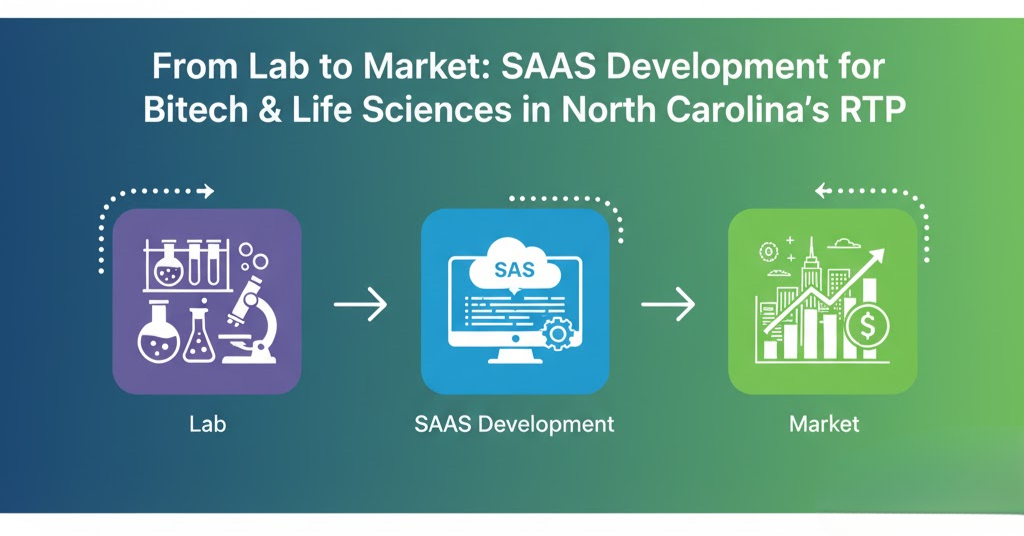
From Lab to Market: SaaS Development for Biotech & Life Sciences in North Carolina’s RTP

apidots-main October 31, 2025 9 min read Business

Introduction: Why RTP Is the Perfect Soil for SaaS Innovation

In the heart of North Carolina lies a powerful engine of life-science innovation: Research Triangle Park (RTP). Stretching over 7,000 acres and hosting more than 300 companies, RTP combines the research strength of top-tier universities (Duke, UNC, NC State) with a thriving biotech and life-sciences ecosystem. Wikipedia+1

For biotech companies—from small startups to large multinationals—transforming laboratory discoveries into market-ready products is a challenge. One increasingly vital tool in that journey is custom SaaS (Software as a Service). Specialized SaaS platforms help life sciences firms manage workflows, compliance, data, and collaboration more effectively than generic software solutions.

As RTP continues to expand its biomanufacturing and R&D capabilities, the demand for finely tuned, industry-specific SaaS is rapidly growing. In this article, we’ll explore why SaaS development is becoming essential in RTP’s biotech landscape, how companies are leveraging it, and what the future holds.

Why Biotech & Life Sciences Need Custom SaaS in RTP

Off-the-shelf software can only go so far for companies working in biotech and life sciences. The problems they face are specialized: regulatory compliance, lab workflow management, data traceability, clinical trials, and collaboration across scientists, CROs, and manufacturing sites. Here’s how custom SaaS solutions bridge that gap.
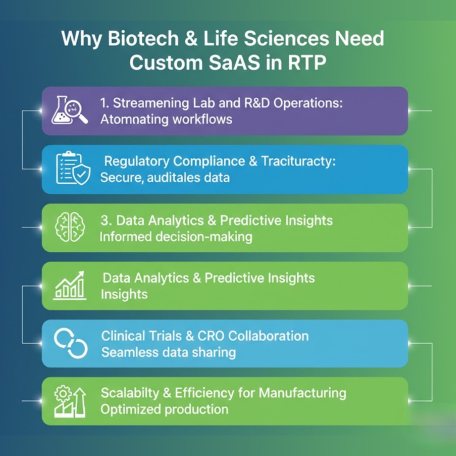
1. Streamlining Lab and R&D Operations

Biotech labs adopt SaaS to help manage complex, highly regulated workflows:

  • Electronic lab notebooks (ELNs): Scientists can record experiments, track reagents, and link results to specific batches.
  • Quality management systems (QMS): Custom SaaS ensures SOPs (standard operating procedures) are followed, deviations are logged, and audits are easier.
  • Collaboration and data sharing: Platforms allow cross-functional teams—including academic collaborators, CROs, and manufacturing groups—to work from a unified, secure system.

2. Regulatory Compliance & Traceability

Life science regulations (e.g., FDA, EMA) demand traceability across every stage:

  • Custom SaaS helps maintain audit trails, version control, and electronic signatures, which are crucial for validation.
  • For biomanufacturing companies, having a secure, cloud-based system ensures batch-to-batch data integrity, easier reporting, and regulatory readiness.

3. Data Analytics & Predictive Insights

RTP’s biotech companies are increasingly leveraging data science, and SaaS platforms make this scalable:

  • SaaS built specifically for biotech can integrate lab data, assay results, and production metrics.
  • Machine learning models help predict yield, optimize processes, and flag anomalies early.
  • Real-time dashboards enable decision-makers to track KPIs across R&D and manufacturing in a single view.

4. Clinical Trials & CRO Collaboration

Many life sciences companies in RTP use custom SaaS to streamline clinical operations:

  • Platforms integrate patient enrollment, trial protocols, sample tracking, and outcome data.
  • Collaboration with CROs becomes seamless—data is shared securely, updates are synchronized, and regulatory reports are generated automatically.
  • Specialized SaaS helps monitor trial compliance, reducing the risk of non-compliance.

5. Scalability & Efficiency for Manufacturing

As companies move from R&D to production, their digital needs change:

  • A well-built SaaS platform can scale with a company’s growth—from small-scale trials to full GMP manufacturing.
  • Modules designed for manufacturing operation management help coordinate production schedules, supply chains, and quality control.
  • In RTP, where companies like Biogen are investing heavily in manufacturing capacity, scalable SaaS becomes mission-critical. NC Capital Group

Real-World Examples & Case Studies in RTP

Biogen’s Growth
Biogen’s $2 billion RTP expansion is not just about building physical capacity—it reflects the need for digital systems that can support high-volume, regulation-heavy biomanufacturing. NC Capital Group+1 A custom SaaS solution tailored for their RTP operations could help ensure data integrity, optimize production, and manage compliance across facilities.

Locus Biosciences
Locus Biosciences, based in RTP, develops CRISPR-based bacteriophage therapies. Wikipedia A SaaS tool focused on precision medicine could help their scientists manage complex workflows, maintain records for regulatory purposes, and collaborate with academic partners.

Rho Clinical Research
Rho, a contract research organization (CRO) in RTP, employs hundreds of clinical research experts. ncbiotech.org A bespoke SaaS solution could streamline trial management, patient tracking, and data analysis, improving efficiency and making CRO operations more transparent and compliant.

Why SaaS Development in RTP Makes Business Sense

A Rich Talent Pool & Academic Pipeline

The Triangle region benefits from three major research universities—Duke, UNC-Chapel Hill, and NC State—that continually produce life science and engineering talent. innovationtrivalley.org+1 For a SaaS developer, that means access to experts who understand both software and biology.

Strong Investment & Infrastructure

Life sciences investments in RTP remain high. In 2024, North Carolina recorded approximately $10.8 billion in life science funding, including pharmaceutical manufacturing and lab space. WareCRE This capital influx pushes companies to upgrade their digital tools—and SaaS developers to meet the demand.

Cost-Effective Growth Compared to Other Hubs

Compared to biotech hubs like Boston or California, operating in RTP can be significantly more affordable. which is often much lower than in other major hubs. Capital Analytics Associates Lower real estate and operational costs make it more feasible for companies to invest in custom SaaS.

Ecosystem Support

RTP is more than just lab space—it’s a full ecosystem of innovation. With incubators, research institutions, and existing life-science firms, it’s a fertile ground for SaaS companies that specialize in biotech. Tools built here have direct access to potential users and collaborators.

Challenges & Considerations for SaaS Development in Biotech

While the opportunity is massive, building SaaS for biotech is not without its challenges:

  • High regulatory burden: Software must support FDA (or EMA) requirements, which means rigorous validation and documentation.
  • Complex workflows: Biotech labs operate with protocols, deviations, and data points very different from other industries.
  • Security: Data privacy, encryption, and auditability are vital. SaaS solutions need to ensure compliance with FDA 21 CFR Part 11, GDPR (if applicable), and other standards.
  • User adoption: Scientists and lab personnel may be slower to adopt new software unless it’s clearly beneficial and easy to use.
  • Sustainability: SaaS providers must balance feature-rich platforms with the need to remain lean and scalable.

How to Approach SaaS Development for Biotech in RTP

Here are some strategic insights for companies in or around RTP looking to build or invest in biotech SaaS:

  1. Start with domain experts: Assemble a cross-functional team that includes biologists, regulatory experts, and software architects.
  2. Map core workflows: Focus on the most critical processes like sample tracking, lab records, and quality management.
  3. Prioritize compliance from day one: Build audit trails, digital signatures, and access controls into the early MVP.
  4. Use cloud-native architecture: Design your SaaS with scalability in mind so it can grow with your users—from R&D labs to manufacturing.
  5. Design for usability: Create interfaces that scientists find intuitive—something that simplifies their day rather than complicates it.
  6. Integrate analytics: Provide data dashboards and predictive models so customers can glean value beyond just record-keeping.
  7. Pilot locally: Use RTP’s ecosystem to beta-test with nearby life-science firms before scaling out.
  8. Build partnerships: Collaborate with CROs, contract manufacturing organizations (CMOs), and local biotech companies.
  9. Adopt a flexible pricing model: Offer tiered plans to serve small biotech startups as well as large biomanufacturers.
  10. Plan for long-term support: Provide training, validation assistance, and continuous upgrades to keep your SaaS relevant.

Future Trends: Where RTP’s SaaS-Biotech Intersection Is Headed

  • AI & Machine Learning: Predictive modeling for cell culture, yield forecasting, and QC anomaly detection are already gaining traction.
  • Digital Twins: Virtual replicas of bioreactors or lab processes could help companies simulate and optimize biological production before physical runs.
  • Blockchain for traceability: Ensuring provenance of biological materials (cell lines, reagents) to support reproducibility and regulatory audits.
  • Edge computing in labs: On-site computation for real-time data processing from instruments—reducing latency and improving response times.
  • SaaS-enabled biomanufacturing: Cloud-based manufacturing execution systems (MES) that seamlessly integrate with production lines, enabling scalable and compliant bioproduction.

Why API DOTS Is a Partner Worth Considering

At API DOTS, we specialize in building custom SaaS solutions tailored to domain-specific needs—especially for biotech and life sciences companies in innovation hubs like RTP. With expertise in secure API development, cloud-native architecture, and compliance-focused design, we help clients translate their lab workflows into scalable, efficient, and compliant digital platforms.

Whether you’re a startup developing gene therapies or a large biomanufacturer expanding your footprint in RTP, our development process emphasizes collaboration, validation, and long-term usability.

Key Takeaways

  • RTP is a global biotech powerhouse, and its life sciences ecosystem demands specialized SaaS to function efficiently.
  • Custom SaaS platforms enable biotech firms to manage labs, trials, compliance, and collaboration in a way that generic software can’t.
  • Real-world momentum—like Biogen’s $2B expansion—underscores the need for scalable, auditable, and intelligent software.
  • Challenges are real (regulatory, adoption, security), but they’re surmountable with the right strategic approach.
  • The future is promising: AI, digital twins, and edge computing will drive the next generation of biotech SaaS in the Triangle.
  • API DOTS is uniquely equipped to support this journey, combining domain expertise with technical excellence.

Conclusion & Call to Action

The journey from lab to market is rarely straightforward—but in North Carolina’s Research Triangle Park, the ecosystem is built to support it. SaaS development is no longer a luxury for biotech firms; it’s a critical piece of how they scale, innovate, and stay compliant.

If you’re based in RTP—or thinking of starting a life sciences company here—and you want to turn your lab workflows into powerful, scalable software, contact API DOTS today. Let us help you build a custom SaaS solution that meets your scientific goals, regulatory needs, and business ambitions.

We Build Business Solutions That Drive Measurable Outcomes

We create custom digital systems tailored to your operations.Focused on efficiency, scalability, and sustainable growth.

Consult Business Experts
Share Article:
apidots-main

Your email address will not be published. Required fields are marked *