
Top
Search
People also search for:
Stay Inspired with Instagram





Choosing the right web development framework in 2025 is no longer just a technical decision—it’s a long-term business strategy. For organizations building scalable digital platforms, understanding the enterprise web development process and its business benefits is equally important when selecting the right technology stack.
Despite predictions about PHP fading away, Laravel continues to grow stronger. It powers enterprise platforms, SaaS products, APIs, and high-traffic applications worldwide. Backed by a massive ecosystem, predictable updates, and strong community support, Laravel has evolved into far more than just a PHP framework—it’s a complete development platform.
In this blog, we’ll explore why Laravel remains dominant in 2025, how its ecosystem supports scalability and performance, and why it is positioned to stay relevant through 2030 for businesses planning long-term digital growth.
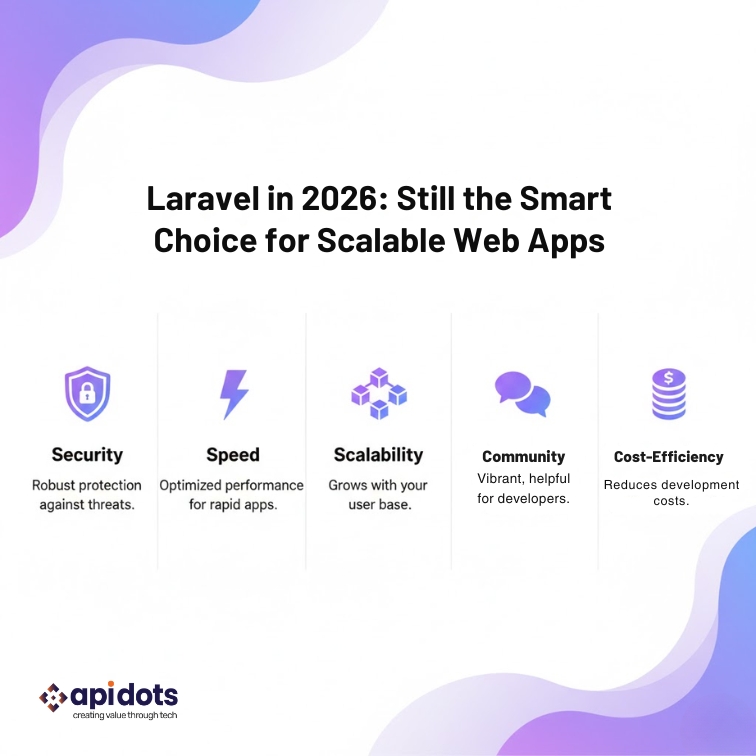
Key Takeaways
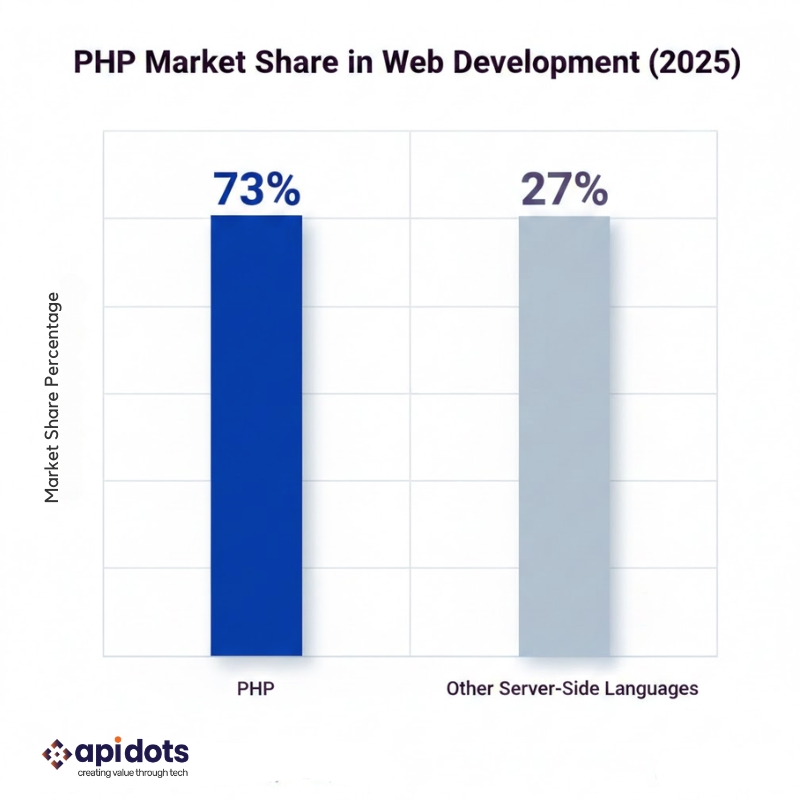
Despite headlines predicting PHP’s decline, PHP still powers about 73% of websites with a known server-side language (as of August 2025). Even in the top one million websites, PHP holds close to 70% market share, and modern versions (PHP 8.x and above) now account for nearly half of that. This shows active upgrading rather than stagnation.
Laravel has become the de-facto modern PHP framework, giving businesses the best of both worlds:
With an enormous base of PHP developers and clear migration paths, Laravel projects avoid the hiring and scaling issues that niche frameworks often face.
One of Laravel’s greatest strengths is its clear release cadence and support policy. The current major version, Laravel 12, ships with:
This predictable cycle gives engineering leaders and product teams confidence to plan for the long term. You know exactly when to expect updates, and upgrades are incremental, not painful rewrites.
Laravel is no longer just a framework. It has grown into a full platform ecosystem that covers everything from development to deployment:
Laravel has become a popular choice for businesses building scalable cloud platforms and subscription-based software. Its modular architecture, built-in authentication systems, and powerful database management tools make it ideal for developing multi-tenant applications that serve thousands of users simultaneously. Because of these capabilities, many technology companies rely on Laravel for SaaS product development, allowing them to launch, scale, and maintain software platforms efficiently while keeping development costs under control.
Laravel’s adoption speaks for itself:
This community energy means you’ll find documentation, tutorials, and talent everywhere. Training new developers is faster, and solving edge cases is easier when thousands of people have likely faced the same issue.
Laravel has evolved beyond a simple backend framework and now plays a critical role in building scalable and feature-rich platforms. Businesses today rely on frameworks that can support dynamic interfaces, robust APIs, and seamless integrations with third-party services. Laravel simplifies this process by offering powerful tools, clean architecture, and built-in features that speed up development. As a result, Many companies choose Laravel for custom software development for business because of its flexibility and long-term scalability.
Starter kits like Laravel Breeze and Jetstream make bootstrapping projects even faster. Combined with Livewire and Inertia, you can deliver modern web apps in weeks instead of months—without managing two separate codebases.
Performance has long been a priority for Laravel:
This flexibility lets you start lean and scale as your user base grows—no need to re-platform.
Laravel’s conservative defaults and strong documentation make it easy to build secure applications. Features like CSRF protection, policy-based authorization, and input validation reduce common vulnerabilities. And thanks to its clear 2-year security patch cycle, enterprises can meet compliance requirements without guesswork.
The PHP language itself has evolved dramatically in recent years. With PHP 8.3 and 8.4, developers benefit from:
Laravel stays on top of these updates, ensuring projects can take advantage of the latest PHP features without waiting years for compatibility.
Laravel doesn’t just make developers happy—it makes financial sense:
Over a five-year horizon, these advantages add up to major cost savings while keeping your product moving fast.
Planning a scalable web application? Explore how our Laravel development experts can help you build secure and future-ready platforms.
All signs point to yes. PHP remains dominant, Laravel continues to innovate, and its ecosystem is stronger than ever. Unless the entire web development landscape undergoes an unprecedented shift, Laravel’s balance of speed, scale, and stability will remain unmatched.
If you’re starting a new web project in 2025—or planning a long-term platform strategy—Laravel remains a safe, powerful, and future-proof bet. It’s fast to develop, flexible to scale, and backed by one of the most active communities in web development. Five years from now, you’ll be glad you chose it.
Looking for Expert Laravel Development?
At API DOTS, we specialize in building robust, scalable, and future-ready web applications using Laravel and modern PHP standards. Whether you need a high-performing API, an enterprise-grade platform, or a secure SaaS solution, our team delivers with precision and speed. Let’s turn your ideas into reality with Laravel’s power.
Frequently Asked Questions (FAQs)
1. Is Laravel suitable for enterprise-level applications?
Yes, Laravel is widely used for enterprise applications due to its scalability, security features, and structured architecture. With tools like Octane, queues, and Laravel Vapor, businesses can handle high traffic and complex workflows efficiently. Its long-term support cycle also makes it reliable for large-scale projects.
2. Why is Laravel still relevant in 2025 despite new frameworks?
Laravel continues to evolve alongside modern PHP updates. Its predictable release cycle, strong ecosystem (Forge, Vapor, Nova, Livewire), and large developer community ensure it stays competitive with newer frameworks while maintaining long-term stability.
3. Is Laravel secure for building SaaS platforms?
Yes. Laravel includes built-in security features such as CSRF protection, authentication scaffolding, policy-based authorization, encryption, and input validation. Combined with regular security updates, it provides a strong foundation for secure SaaS and enterprise applications.
4. Can Laravel handle high-performance APIs?
Absolutely. With Laravel Octane, caching systems, and queue management tools like Horizon, Laravel can support high-performance APIs and real-time applications. It also integrates seamlessly with cloud platforms for scalable infrastructure.
5. What makes Laravel a cost-effective long-term choice?
Laravel reduces total cost of ownership through faster development cycles, reusable components, built-in tools, and a large global talent pool. Businesses can scale from small VPS hosting to serverless cloud infrastructure without changing the core framework.
We manage and optimize your IT infrastructure end-to-end.Ensuring stability, security, and operational continuity.
Consult IT Experts
Hi! I’m Aminah Rafaqat, a technical writer, content designer, and editor with an academic background in English Language and Literature. Thanks for taking a moment to get to know me. My work focuses on making complex information clear and accessible for B2B audiences. I’ve written extensively across several industries, including AI, SaaS, e-commerce, digital marketing, fintech, and health & fitness , with AI as the area I explore most deeply. With a foundation in linguistic precision and analytical reading, I bring a blend of technical understanding and strong language skills to every project. Over the years, I’ve collaborated with organizations across different regions, including teams here in the UAE, to create documentation that’s structured, accurate, and genuinely useful. I specialize in technical writing, content design, editing, and producing clear communication across digital and print platforms. At the core of my approach is a simple belief: when information is easy to understand, everything else becomes easier.