
Top
Search
People also search for:
Stay Inspired with Instagram




In today’s fast-evolving medical landscape, enterprise healthcare software has become a cornerstone of innovation. Hospitals, clinics, and research centers are under pressure to modernize their IT systems while safeguarding patient safety and data integrity.
According to the precedence research the demand is enormous – the global healthcare IT market was valued at $760 billion in 2024 and is projected to soar past $3.3 trillion by 2034. Health tech buyers, software developers, and investors all recognize that custom enterprise solutions can drive better patient care and operational excellence.
Nevertheless, unlocking this potential required us to confront significant hurdles: strict medical compliance regulations in various countries, persistent threats from cyberspace, and, based on our discussion with the CIO of a large, multi-speciality group, the requirement to connect numerous systems and related data with minimal friction. Modern enterprise healthcare platforms must balance security, usability, and interoperability and be future-ready (meaning built with an ability to accommodate and evolve with new regulations and patient expectations).
This article considers how custom healthcare software is providing solutions to these hurdles – exploring ideas such as global regulatory compliance (e.g., HIPAA, GDPR, HL7, ISO), data security and trust, improved patient outcomes and enhanced efficiency, and the latest technology trends (e.g. telehealth, AI diagnostics, EHR interoperability, and healthcare data analytics) shaping the industry.
In the healthcare sector, compliance is not negotiable; it is foundational. As the requirement for risk assessment has broadened from a solely medical to an accompanying security scope, the compliance of enterprise software to such regulations is a must. A set of frameworks which different countries require includes:
The issue of legal system confusion is known to practically every software designer employed across record management, where many countries share the same system of law but take different directions. For instance, a designer of a software may have to deal with compliance such as HIPAA regulation in the US, WDG in the EU and separate country regulations elsewhere.
For example, PIPEDA in Canada and PDPL in the Middle East introduce even more privacy obligations. This regulatory fog can be challenging to navigate: rules are constantly changing, and noncompliance often leads to fines and/or lawsuits. With that said, leading enterprise healthcare software solutions generally have embedded compliance-first perspectives:
In fact, meeting these strict frameworks is seen as “the baseline for trust” in any healthcare platform.
Staying compliant is an ongoing effort. Organizations are required to keep track of developing healthcare regulations, from FDA software guidance to new ISO releases. As one industry observer puts it,
“New tools and paradigms are being developed faster today than regulators can track. From AI diagnostics to a blockchain model for medical records to IoT devices, the pace of innovation outstrips the constructs used to rein them in.”
Enterprise developers do this by engaging compliance officers at the onset of and throughout the development process, which ensures that every feature (no matter whether it is a telehealth module or a data analytics dashboard) is built in accordance with the intended medical compliance rules. By incorporating global regulatory compliance into every possible shape of the software, modern healthcare software is able to establish a foundation of trust and legal adherence for developers in many markets.
Alongside compliance is the important component of data security and patient privacy. Healthcare data is sensitive – there are few data types more valuable, or that criminals won’t try to breach, than patient records. A breach or leak is capable of vanquishing all trust in a provider with zero notice and few opportunities to recoup. The enterprise healthcare software must thus develop in earnest security to ensure confidence in data is preserved, confidentiality is respected, and the health of the data is protected.
The modern software schemes use a defence-in-depth approach to security. The current protocols include encrypting data when being transmitted, and when being stored, and having strong user authentication (multi-factor.
Moreover, cloud adoption in healthcare has led to “cloud healthcare platforms” that offer built-in security and scalability – leading vendors leverage cloud infrastructure for scalability while maintaining stringent security practices.
Despite best efforts, threats remain very common. Ransomware attacks on hospital systems and data breaches make headlines worldwide. The fallout from a single breach is severe: lawsuits from patients, hefty fines, reputational damage, and, most critically, potential risk to patient care if records are compromised.
For example, an attack that knocks out an EHR system could delay treatments or lead to errors. Therefore, enterprise solutions often integrate advanced cybersecurity tools – from continuous network monitoring and intrusion detection to “zero trust” architectures – to preempt attacks and isolate any breach. Crucially, security design must balance with usability: a system locked down too tightly can frustrate clinicians and hinder care, while one too open invites risk. Achieving this balance is key to provider adoption and sustained trust.
In my view, the privacy of health data is very important. Patients and practitioners need the reassurance that data related to their health is used as intended. Compliance frameworks such as HIPAA and GDPR have formalized protections related to privacy (e.g., consent management, right to access or remove data, etc.), and enterprise software can support compliance by including functionality for features like consent tracking and anonymization/pseudonymization when using data for analytics, audit trails, etc.
In practice, a well-designed software product will log every event of access to, and change of, every patient’s record, meaning that if an unauthorized individual viewed or changed a record, it can be subsequently determined who accessed or modified record. When users and patients see how an organization fosters transparency, it develops trust – an understanding that the platform treats their privacy with the utmost consideration.
In summary, data security and data privacy compliance, at a minimum, is a non-negotiable in health IT. When enterprise healthcare software companies put extensive security measures in place and abide by international regulations regarding privacy, they are creating an atmosphere of trust. Health systems can engage with technology – cloud-based EHR systems, AI-based diagnostic tools, telehealth solutions, etc. – ensuring their patients’ health information is kept secure and private. Trust in this sector is what will allow the digital health space to thrive.
By now, we know that the value of enterprise healthcare software boils down to its effect on quality of care and organizational performance. These custom software solutions are changing the way providers deliver care, frequently resulting in measurable improvements in patient outcomes and improvements of operational performance.
Enterprise healthcare software delivers multiple wins for stakeholders:
Interoperability is the ability of each of these systems to interact and exchange information. By 2025, interoperability is no longer a nice to have; it is a strategic imperative. Buyers purchasing or investors in health technology are looking for products that can share information into a health ecosystem because an isolated product has limited value. An enterprise software platform that cannot connect or share data will neither scale nor survive in the interconnected healthcare environment. Consequently, custom healthcare software development focuses not just on features, but on compatibility: building with standard APIs, cloud-native integration tools, and a vision of unified patient data. By tearing down the silos, enterprise systems enable the free flow of information that is essential for high-quality, efficient care.
The modern medical landscape is being reshaped by a convergence of advanced technologies.
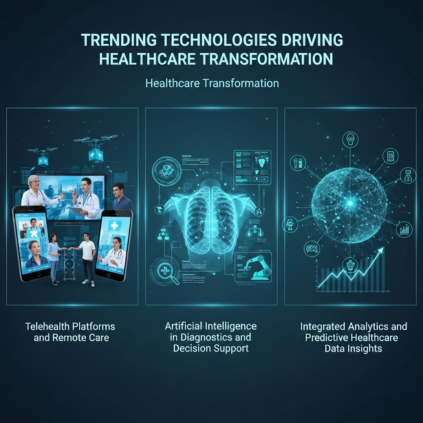
Telehealth platforms have moved from niche offerings to mainstream components of healthcare delivery. Spurred by the COVID-19 pandemic and regulatory flexibilities, telemedicine adoption has skyrocketed.
From a business standpoint, telehealth is expanding service lines and revenue streams for healthcare organizations while lowering costs. The costs of virtual visits can be reduced per encounter, while addressing workforce shortages, because specialists can be anywhere to engage.
Artificial intelligence (AI) is the most intriguing technology in healthcare. In enterprise healthcare software, AI diagnostics, and AI-enabled decision support is a game changer in terms of clinical accuracy and efficiency. This is how:
1. AI systems are trained using machine learning algorithms on diverse robust data sources from medical images, electronic health records, and genomic data, enabling detection and patterns that are often missed by human providers and sometimes even faster. For example, AI tools in the radiology field can review a large volume of X-rays, CT scans, or MRIs and highlight areas of concern.
2. One AI software was “twice as accurate” as human specialists at interpreting brain scans of stroke patients, and another AI model was able to detect 64% of brain lesions associated with epilepsy that radiologists did not identify. These advancements lead to conditions being diagnosed earlier and with greater reliability, providing timely treatment and better patient prognosis.
3. In addition to its application in medical imaging, AI is improving diagnostics in pathology (scanning microscope slides for cancer cells), cardiology (interpreting EKGs or echocardiograms), dermatology (diagnosing skin lesions), and virtually in every clinical speciality.
4. AI diagnostics can also help by interpreting the patient’s symptoms and history to propose possible diagnoses to the clinician (augmented triage), which can help when the clinician has not considered some possible options. AI is not meant to replace clinician judgment – AI is meant to assist clinicians.
5. AI is intended to do the data-crunching and pattern recognition, while freeing physicians to address difficult decision-making and communicating with patients. Of course, the use of AI raises new questions of validation for accuracy and fairness, and the use of these algorithms must be clear and ethical.
Healthcare has always been rich in data – from lab results and imaging studies to clinical notes and now genomics and wearable sensor streams. Healthcare data analytics is the practice of harnessing this data to derive actionable insights, and it is a core feature of modern enterprise healthcare systems. Advanced analytics platforms, often powered by cloud computing and AI, enable health organizations to move from retrospective reporting to predictive analytics and real-time decision support.
One of the most powerful aspects of analytics is the ability to predict and prevent adverse events.
Overall, healthcare data analytics and predictive modelling have become indispensable in driving quality improvement and operational excellence. They exemplify how enterprise healthcare software isn’t just about digitizing records, but about unlocking the value of data to make healthcare smarter. Organisations that successfully leverage analytics are reaping rewards in saved costs, healthier patients, and proactive care delivery – staying a step ahead in the journey toward value-based, data-driven healthcare.
The modern medical landscape demands a new class of enterprise software solutions – those that can be custom-fit to healthcare’s unique needs while upholding the highest standards of compliance, security, and performance.
From ensuring HIPAA and GDPR compliance to embracing interoperability standards and cloud scalability, enterprise healthcare software is the engine powering hospitals and clinics into the future. Equally important, these solutions are delivering real-world benefits: stronger data security and patient trust, measurable improvements in patient outcomes, streamlined operations, and new capabilities driven by technologies like telehealth, AI, and advanced analytics.
In closing, enterprise healthcare software represents the custom solutions driving a modern medical landscape. The most successful solutions are those that seamlessly blend technology with the realities of healthcare: they empower clinicians rather than distract, protect patients’ data while enabling its beneficial use, and adapt to regulatory changes without missing a beat.
As 86% of healthcare leaders affirm, technologies like AI – and by extension, the software that implements them – are “critical to their future,” and over 80% believe these tools will “revolutionize healthcare” in the next 3-5 years. That revolution is already underway. By continuing to prioritize compliance, data security, interoperability, and innovation, enterprise healthcare software will remain at the forefront of delivering better health outcomes and driving business success in the global healthcare industry.
Join Apidots today to create innovative telehealth applications that enable reliable and secure remote healthcare delivery.
We design and develop secure, high-performance web and mobile applications.Ensuring scalability, reliability, and long-term product success.
Hire App Developers