
Top
Search
People also search for:

Stay Inspired with Instagram




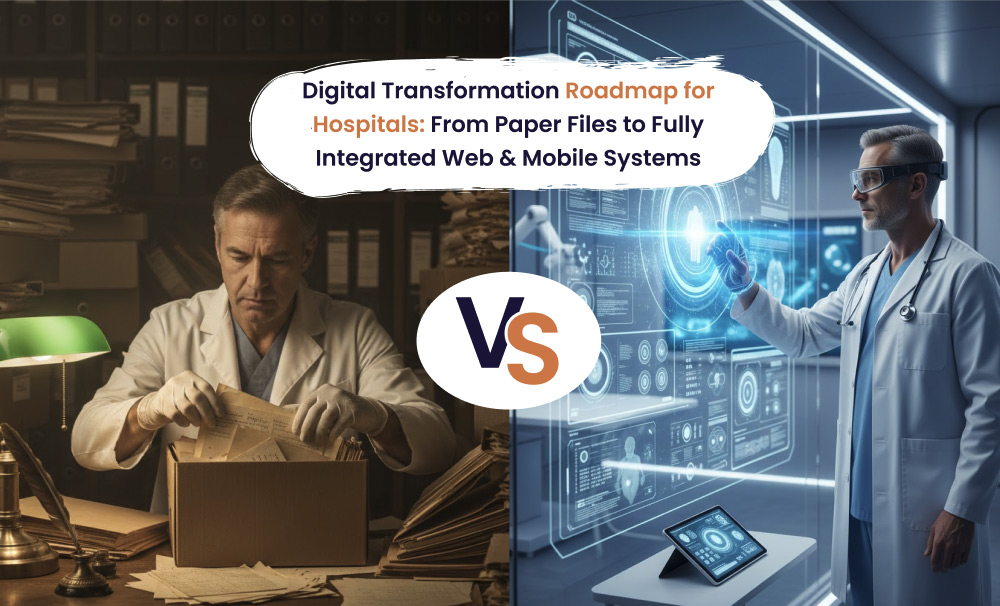
Across hospitals in the USA, Canada, Singapore, Australia, the UK, and Europe, a quiet yet monumental shift is underway. For decades, patient records lived in dusty folders stacked in back rooms. Nurses carried clipboards from ward to ward. Doctors flipped through thick paper files searching for patient histories. Administrators worked late nights reconciling billing sheets manually. And patients endured long queues, repeated form-filling, inconsistent information, and fragmented care experiences.
Today, that world is rapidly dissolving.
The global healthcare ecosystem is finally undergoing the kind of digital transformation that banking, travel, and retail experienced years ago. The pressures are undeniable. Patients expect digital convenience. Clinicians want real-time information. Management needs accurate analytics. Regulators demand accountability. Meanwhile, inefficiencies, human errors, and the cost burdens of legacy systems are pushing hospitals to shift from paper files to a fully integrated web and mobile ecosystem.
This transition is not simply about upgrading software. It is about redefining how hospitals operate—how information flows, how teams collaborate, how patients engage, and how decisions are made. It is about reshaping the very identity of a digital hospital.
Yet, for many healthcare leaders, this journey feels overwhelming. Where should we begin? Which systems matter most? How do we avoid chaos? How do we ensure adoption? How do we manage compliance, interoperability, and security? And, most importantly: How do we create a transformation roadmap that is sustainable and realistic—not disruptive?
This long-form executive guide answers those questions with clarity, strategy, and deep operational insight. It reframes your digital journey not as a technology purchase, but as a structured shift toward efficiency, safety, transparency, and long-term value creation.
Every CXO who has worked in a paper-led hospital understands the pain.
Charts get lost. Diagnoses are incomplete. Lab reports arrive late. Doctors struggle to see the full clinical picture. Patients repeat medical histories endlessly. Billing disputes become common. And management can’t make informed decisions because data is fragmented across spreadsheets, registers, and multiple disconnected systems.
This is no longer sustainable.
In a healthcare environment driven by value-based care, data transparency, interoperability, and patient-centric engagement, paper systems introduce risk across every layer:
Digital transformation is no longer a luxury for hospitals—it is a strategic imperative.
A modern hospital must evolve into an integrated digital organism—combining a robust electronic medical records system, a strong hospital management system, a secure hospital patient portal, and a seamless hospital mobile app backed by a unified data backbone, secure APIs, analytics-driven dashboards, and automated workflows.
This roadmap outlines how executives can reach that destination with clarity and confidence.
A truly digital hospital is not defined by having a mobile app or EHR alone. It is defined by the ability of all systems—clinical, administrative, financial, and patient-facing—to speak to each other through real-time, secure, and structured data exchange.
The transformation moves hospitals from:
This evolution cannot happen overnight. It requires a intentional roadmap, guided leadership, trained teams, reliable partners, and a commitment to long-term digital maturity.
Every powerful transformation begins with brutal honesty.
Before purchasing software, adopting AI, or launching new mobile features, hospital leaders must clearly understand existing processes.
This assessment includes evaluating:
Hospitals in Singapore and Europe often begin digital projects only after a deep workflow analysis—ensuring that digital tools are built for real clinical needs, not theoretical assumptions.
A strong baseline reveals:
This clarity becomes the bedrock for every future digital decision.
The core of any digital hospital transformation is the migration from paper charts to electronic medical records (EMR) or electronic health records (EHR). These systems centralize patient history, diagnoses, medications, allergies, symptoms, imaging summaries, lab results, clinical notes, and treatment plans.
Without EMR/EHR, a hospital cannot achieve true digital transparency or clinical safety.
Hospitals transitioning into EMR/EHR should prioritize:
It must support demographic details, visit history, imaging results, lab orders, prescriptions, discharge summaries, and multi-department workflows.
Not all paper files need digitization.
High-value cases (ICU, surgery, frequent OPD patients) should be prioritized.
EMR/EHR must connect with:
Doctors must access patient data instantly on screens instead of searching through files—this dramatically improves safety and continuity of care.
In North America and Europe, EMR/EHR adoption is often tied to regulatory requirements for data standardization, value-based care, and clinical decision support.
These systems become the central nervous system of the hospital.
Once EMR/EHR is in place, a hospital management system (HMS) or hospital information system (HIS) becomes the single operational engine connecting clinical, financial, administrative, and logistical workflows.
A strong HMS/HIS governs:
Modern HMS platforms prioritize:
In Canada and Europe, hospitals increasingly prefer secure cloud-based HMS systems for improved uptime, disaster recovery, and centralized data governance.
The HMS becomes the operational backbone supporting every interaction across the digital ecosystem.
Once the internal foundation is stable, hospitals can confidently expand outward through patient-facing digital channels.
This three-layer strategy builds the digital front door for patients.
A hospital website is no longer a static brochure. It is a functional care gateway that must support:
In many regions—especially Australia, USA, and UK—the hospital website is the first touchpoint for new patients. It must establish trust instantly.
A secure patient portal directly connected to EMR/EHR and HMS empowers patients to:
When built correctly, a patient portal reduces call center traffic dramatically and increases patient satisfaction.
A hospital mobile app becomes the most powerful long-term digital asset.
Patients may visit occasionally, but they use their smartphones daily—making apps ideal for ongoing engagement.
A modern hospital mobile app includes:
This app becomes the patient’s daily connection point to the hospital—transforming it into a true digital companion for care.
Digital transformation fails when systems remain isolated.
Integration is the glue of a digital hospital.
The following integrations are essential:
Enables automatic ordering, tracking, and delivery of lab reports.
Allows radiologists to store and share images with clinicians instantly.
Connects prescriptions to dispensing workflows.
Ensures transparency and accurate claims.
Integrates clinical-grade data from at-home devices into EMR/EHR.
Helps doctors make faster, safer decisions.
Industry standards that ensure future scalability.
With proper integration, hospitals achieve:
This is the essence of integrated digital hospital systems.
Telehealth is now a core pillar of modern care—not a pandemic workaround.
Hospitals today are embracing:
Remote patient monitoring closes the loop by feeding data from wearables and home devices (blood pressure monitors, glucose meters, SpO₂ sensors) back into the ecosystem.
This transforms chronic care, reduces hospital readmissions, and supports value-based reimbursement models.
In digital-advanced geographies like Singapore, the UK, the Netherlands, and certain states in the USA, RPM is becoming a central part of chronic care programs.
Most digital transformation projects in hospitals fail not because the technology didn’t work, but because people never adopted it.
Successful change management includes:
When staff feel empowered—not overwhelmed—digital transformation becomes sustainable.
Healthcare data is the most sensitive category of personal data.
A hospital’s digital ecosystem must enforce:
Even the strongest digital ecosystem collapses without trust and security.
Once the hospital functions digitally, analytics becomes transformative.
Executives gain access to:
Analytics transforms management from reactive decision-making to strategic planning
Digital transformation is not a sprint.
It is a carefully phased journey involving:
Hospitals that move in clear phases—rather than deploying everything at once—see far better adoption and ROI.
A hospital’s digital success depends heavily on the right long-term partner—one that understands:
The right partner becomes an extension of the hospital—not just a vendor.
Digital transformation for hospitals is not about “going paperless.”
It is about building a fully integrated digital ecosystem that supports every step of the patient journey and every layer of hospital operations—clinical, administrative, and financial.
Hospitals that follow a structured roadmap, prioritize EMR/EHR, adopt a powerful HMS, build patient-facing digital tools, strengthen integration, invest in telehealth, and embrace analytics will become the leaders of tomorrow’s healthcare landscape.
A truly digital hospital is safer, smarter, faster, more efficient—and far more satisfying for both patients and staff.
And most importantly:
It becomes the foundation for better care, better decisions, and better outcomes—on screen and on the ground.
We design and develop secure, high-performance web and mobile applications.Ensuring scalability, reliability, and long-term product success.
Hire App Developers
As a technology-driven web designer specializing in healthcare solutions, I create digital experiences that bridge the gap between medical professionals and modern patient expectations. With a strong focus on usability, interoperability, and future-ready interfaces, I design platforms that simplify clinical workflows, improve patient engagement, and support secure, data-driven healthcare ecosystems. My work blends clean UI/UX with practical healthcare insight, helping hospitals, clinics, and healthtech startups adopt smarter, more efficient, and patient-centric digital solutions.