
Top
Search
People also search for:

Stay Inspired with Instagram




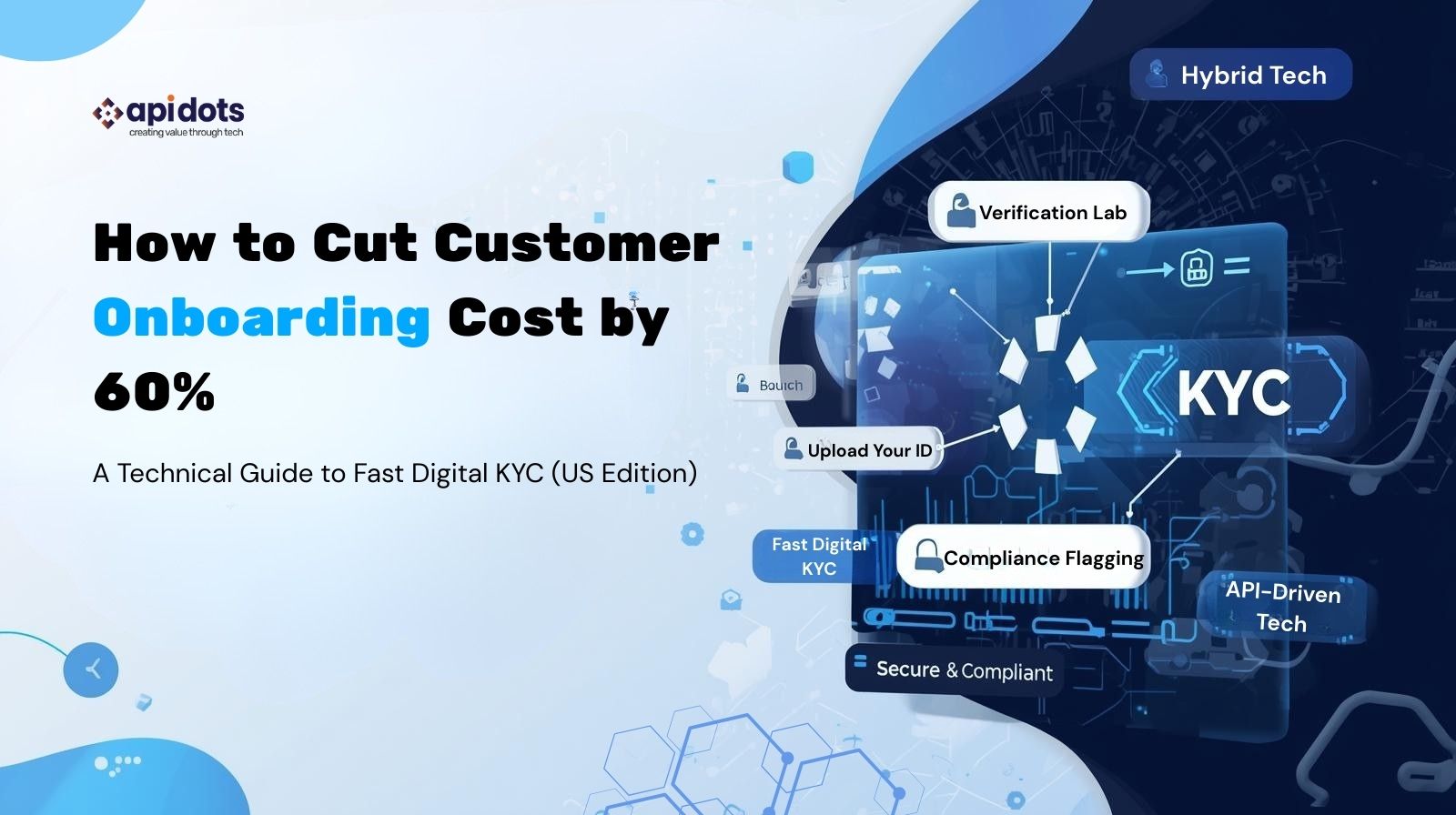
US BFSI onboarding is expensive due to strict KYC, AML, and OFAC compliance, compounded by manual checks and legacy systems. This guide shows how automated digital KYC can cut onboarding costs by up to 60% using real-time identity verification, risk-based scoring, and continuous AML monitoring. APIDOTS enables API-first integration, enabling these capabilities to be deployed quickly and at scale.
Customer onboarding is one of the most expensive and complex processes for banks, credit unions, fintechs, and insurance providers in the United States. Between the Bank Secrecy Act (BSA), FinCEN reporting requirements, Patriot Act KYC mandates, OFAC watchlist screening, and the constant threat of fraud, financial institutions spend millions each year just to verify the identity of new customers.
The challenge is clear: slow, manual onboarding processes drive costs up, frustrate customers, and reduce conversion rates. The solution lies in fast, automated digital KYC systems that comply with US regulations while lowering operational overhead. With the right architecture, BFSI organizations can cut customer onboarding costs by up to 60% and reduce drop-offs by 40–55%.
In this guide, we break down technical strategies, tools, and workflows to implement a fully automated, cost-optimized onboarding system tailored for the US market. Companies that adopt API-first integration models demonstrate how modern digital KYC can streamline compliance, minimize fraud, and boost operational efficiency.
To make this easier to understand, think of digital KYC as a layered assembly line rather than a single verification step. Each layer removes manual work, reduces risk, and lowers cost.
The customer uploads an ID and takes a selfie through a web or mobile app. No branch visits, no paperwork, no manual form filling.
AI and compliance APIs instantly verify:
What used to take hours or days now takes under two minutes.
The system automatically checks the customer against:
All checks happen silently in the background without slowing onboarding.
Instead of treating every applicant the same:
This alone eliminates up to 60% of unnecessary manual reviews.
Multi-layer fraud detection identifies:
Catching fraud early prevents downstream losses and regulatory exposure.
Customers digitally sign disclosures and provide consent under the US E-Sign Act. No physical documents, no delays.
Even after approval, accounts are continuously monitored for suspicious activity, with automated alerts and SAR generation when needed.
This approach:
Instead of expanding compliance teams, organizations rely on automation, APIs, and risk intelligence.
Customer onboarding in the United States is notoriously expensive due to a combination of strict regulatory requirements, fragmented processes, rising fraud risks, and legacy systems. Unlike other regions, the US financial ecosystem enforces multiple overlapping compliance frameworks that make manual onboarding extremely labor-intensive and slow.
US financial institutions must comply with multiple regulations simultaneously. The BSA requires continuous monitoring of transactions and SAR/CTR reporting. FinCEN mandates suspicious activity reporting and detailed audit trails. The Patriot Act’s Customer Identification Program (CIP) obligates institutions to verify identities using reliable, independent sources.
Each new customer requires manual data collection and cross-verification, driving up labor costs and extending onboarding timelines.
Every customer must be screened against OFAC SDN lists and other global sanctions databases at onboarding and periodically afterward. Manual screening requires dedicated teams and increases both cost and risk of human error.
The US experiences some of the highest identity fraud rates globally. Synthetic identities, stolen SSNs, and advanced document forgeries force institutions to add multiple manual-review layers, increasing costs and error rates.
Many banks and credit unions still rely on disconnected systems and paper-based approvals. Customer data is collected repeatedly, stored in silos, and manually reconciled, adding delays and operational expense.
Customers expect instant digital onboarding. Delays caused by manual checks increase abandonment rates and force institutions to spend more on follow-ups and customer support.
In addition to federal regulations, institutions must manage AML, state-level KYC policies, and cross-border compliance, all of which increase onboarding complexity and cost.
Even partially automated organizations face integration challenges among KYC, fraud, CRM, and core banking systems, necessitating manual intervention that negates efficiency gains.
Reducing customer onboarding costs by up to 60% requires a layered digital KYC architecture that automates verification, applies risk-based decisioning, and integrates compliance in real time.
AI-powered KYC tools automate SSN validation, ID verification, biometric matching, and CIP documentation. Manual verification costs drop by 40–50%, and identity checks are completed in minutes.
Real-time sanctions screening embedded into onboarding reduces compliance workload by 25–35% while ensuring no high-risk customer is missed.
Tiered risk models auto-approve low-risk users, apply enhanced checks to medium-risk cases, and reserve manual reviews for high-risk applicants.
Pre-built SDKs for web and mobile reduce development time, improve accessibility compliance, and lower maintenance overhead.
Device intelligence, behavioral biometrics, synthetic identity detection, and SSN correlation significantly reduce fraud losses and false positives.
AML monitoring begins during onboarding, not after account creation, reducing downstream compliance cost and risk.
Digital consent capture under the E-Sign Act eliminates paper-based bottlenecks and accelerates activation.
Secure, encrypted, event-driven architectures with complete audit logs enable rapid scaling and regulatory readiness. API-first integration platforms unify identity, compliance, and fraud services into a single workflow.
This workflow reduces onboarding time from days to minutes while dramatically cutting operational costs.
US BFSI organizations can transform onboarding by adopting fully automated, API-first KYC stacks that combine identity verification, sanctions screening, fraud prevention, and AML monitoring.
The result is faster approvals, lower compliance costs, reduced exposure to fraud, and higher conversion rates. The future of onboarding is fast, compliant, and automated.
Still relying on manual onboarding or disconnected compliance tools? APIDOTS helps US banks, fintechs, and insurance providers design and integrate API-first digital KYC architectures that reduce onboarding costs, accelerate approvals, and maintain full regulatory compliance.
Talk to APIDOTS today to build a faster, smarter, and audit-ready onboarding system.
We develop compliant fintech and digital banking solutions.Designed for security, performance, and regulatory confidence.
View BFSI Solutions
As a technology-driven web designer specializing in healthcare solutions, I create digital experiences that bridge the gap between medical professionals and modern patient expectations. With a strong focus on usability, interoperability, and future-ready interfaces, I design platforms that simplify clinical workflows, improve patient engagement, and support secure, data-driven healthcare ecosystems. My work blends clean UI/UX with practical healthcare insight, helping hospitals, clinics, and healthtech startups adopt smarter, more efficient, and patient-centric digital solutions.