
Top
Search
People also search for:

Stay Inspired with Instagram




Visualize your digital shop as a product catalogue. It is a living, breathing ecosystem of inventory levels, payment gateways, fulfillment, marketing platforms, and customer databases all working together. Customers are expecting swift page load speeds, true inventory counts, an efficient checkout experience, immediate updates on orders, and personalized messaging. Any disruption along this path can result in lost sales and wasted trust. This is the value of API integration services for e-commerce websites—connecting separate systems through APIs (Application Programming Interfaces) allows the e-commerce platform to deliver not just functionality, but an experience worth a customer’s time.
More recent articles demonstrate how e-commerce APIs have shifted from being an afterthought for technology to being embedded as part of the business growth process. Take, for example, a document dated 2025 that states API integrations exist to operate a business, elevate customer experience, and create a method of scale. For a current e-commerce organization, adopting an API-based architecture is a matter of strategy—not a matter of choice.
At its core, an API is a set of rules and protocols that allows one software system to request data or actions from another. In an e-commerce context, this might mean your website asking the inventory management system for stock levels, your checkout process sending payment to a gateway, or your CRM pulling purchase history to tailor a marketing campaign.
A recent article describes API integration as “the glue binding your favorite apps and platforms … ensuring they talk to each other and get things done without breaking a sweat.” TekRevol In e-commerce specifically, that means your storefront, back-office systems, and customer touchpoints all live in sync.
There are different types of APIs: RESTful, GraphQL, SOAP, public, private, and partner. The architecture you select should be consistent with your e-commerce strategy, platform, and scalability requirements. SoloWay
When your systems are independent, you have to replicate data, update it manually, or encounter latency. Oversells, conflicting information, or delayed shipping updates erode customer trust. API integration synchronises data across systems instantly. One blog noted: “APIs help businesses implement new features and services quickly… they improve customer experience by enabling real-time updates and personalised services.” Patternica
Users don’t care about your backend systems—they care about how things work. When inventory is accurate, checkout is smooth, shipping updates are timely, and service is responsive, it builds trust. API integration enables these user-facing wins. According to another source, integration “enhances user experience by enabling seamless transactions, automating back-end processes, improving security, and allowing for greater flexibility and scalability” in e-commerce.
As you expand your catalog, launch new channels (mobile, marketplace, social commerce), or enter new geographies, your backend must scale. With APIs, you are able to add new services without having to rewrite your entire platform. Modular expansion is possible without the need to entirely rebuild everything at once. Your architecture will help you be more future-proof and flexible.
Using existing APIs or integrating third-party services is cheaper and faster than building everything from scratch. One article reported that companies utilising API integration saw measurable improvement in digital transformation success and cost efficiency. The ability to launch new features or integrations quickly becomes a competitive advantage.
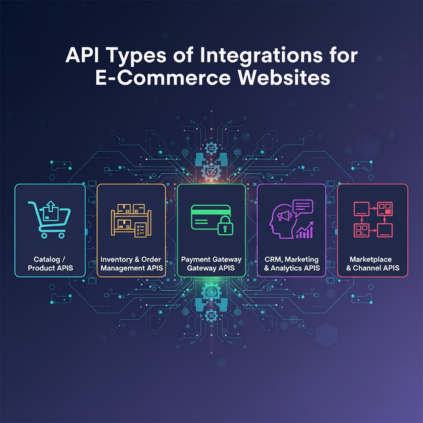
Managing your product information is done through these APIs, such as attributes, images, price, and availability across channels. Synchronising this via APIs ensures every touchpoint reflects the same data, reducing errors and inconsistencies. MapMyChannel
Stock levels, order creation, fulfilment status, returns—all these elements rely on APIs to work fluidly. When orders flow from the storefront to fulfilment and shipping through APIs, you reduce manual overhead and delays.
There are a number of pros of using integrated services like Stripe, PayPal, or other regional gateways through APi. The most obvious one is to have a seamless checkout and expedited funds. Another advantage of APIs is the ability to securely and in compliance transact. The majority of the shipping carriers provided APIs for generating labels, tracking updates, rates, and a multi-carrier logic for these engine integrations allows you to automate the fulfilment workflows in your store, with your customers being notified in real-time.
We know that retention and personalization require rich data. APIs simply connect order history, browsing behaviour, and marketing systems in order to serve targeted offers, loyalty programs, and campaigns based on data.
If you are selling on Amazon, eBay, Etsy, or social commerce channels, APIs will allow you to manage listings, sync inventory, and aggregate orders from one dashboard as needed. That simplifies multi-channel commerce dramatically. Patternica
Just think of a visitor who, after successfully landing on your page, sees accurate stock levels. Then it’s most certain that he wants to add to the cart and rushes to checkout within seconds; the checkout process runs smoothly without a glitch in the system. Behind each of those steps, there are multiple, connected systems performing in real time. APIs make that seamless. When a user sees “only 2 left” or gets a live shipping update, it builds transparency and trust.
Personalized experiences—such as recommended products or returning-customer perks—are also powered by data that flows through APIs. Real-time syncing means the same user behavior data can trigger marketing actions, update loyalty points, and dynamically adapt the storefront. It is this combination of technology and user experience (UX) that elevates an average online store to a successful one.
Prior to researching APIs or vendors, consider the user-pain or business need that you are solving for your business: Are you seeing high cart abandonment? Are you having trouble with inventory errors? Is your multi-channel expansion on hold? The better you define measurable KPIs, the more certain you can be that your integration investment is aligned with delivered outcomes.
Take a full audit of your technology stack: the storefront platform, ERP/IMS, CRM, shipping providers, payment gateways, and marketplaces. You must have a clear understanding of where the majority of data is coming from, how it flows, and where there are bottlenecks or overlaps.
Until now, you get it that not all APIs are the same. Make sure to conduct proper research: documentation, versioning, support, compliance (e.g., PCI-DSS, GDPR), latency, and price. Choosing a provider that offers a good ecosystem will help your project run smoothly by offering guidance on integrations.
Opening API access introduces risk. Ensure endpoints use strong authentication (OAuth2, API keys), encrypted data flows (HTTPS/TLS), logging, rate limiting, version controls, and auditing. A recent article emphasises that without proper design, integration can create “data update delays, order errors and even security vulnerabilities”. SoftTeco
Roll out integrations in phases. Start with low-risk, high-impact endpoints. Just try your hardest and avoid big-bang launches covering multiple regions that can result in massive impacts.
Monitor Key Performance Indicators such as cart abandonment, order processing time, stock-out frequency, customer satisfaction, average order value, and order fulfillment speed. Use dashboards that display these KPIs so that you can measure the ROI of your integration efforts.
APIs evolve. Vendors may update to an entirely new version, discontinue previous versions, or even add new endpoints where you never had them before. You need to reserve budget/time for the ongoing monitoring, updates, and documentation that you implement. One source warns that implementation is not just a project.
For illustration, consider a fashion e-commerce brand that sells on its own website as well as multiple marketplaces. Before integrations, they fought oversells, stock issues, slow checkout, manual fulfilment, and had customer data everywhere. After integrating the following APIs.
The landscape of e-commerce is shifting. “Headless commerce”—where the front-end is decoupled from back-end systems and connected through APIs—is becoming mainstream. With APIs as the backbone, brands can deliver a consistent experience across web, mobile, voice, kiosk, or IoT devices. Composable commerce, real-time personalization (powered by AI), and omnichannel presence all rely on a robust API architecture. The takeaway: if your e-commerce platform isn’t built with integration and flexibility in mind, it risks being outdated.
If you view your online store simply as a product-listing platform, you’re missing the bigger picture. Today’s users seek seamless experiences, and seamless experiences are built on architecture as much as design. API integration services for e-commerce websites offer your brand the ability to scale, adapt, and deliver quality experiences consistently. They turn complex operations into invisible flows, so that the user sees only simplicity and speed. Join Apidots today and enjoy our best API integration services for e-commerce websites to successfully deliver quality experiences.
We engineer robust, future-ready software solutions.Built using modern architectures and proven development practices.
Hire Developers
Hi! I’m Aminah Rafaqat, a technical writer, content designer, and editor with an academic background in English Language and Literature. Thanks for taking a moment to get to know me. My work focuses on making complex information clear and accessible for B2B audiences. I’ve written extensively across several industries, including AI, SaaS, e-commerce, digital marketing, fintech, and health & fitness , with AI as the area I explore most deeply. With a foundation in linguistic precision and analytical reading, I bring a blend of technical understanding and strong language skills to every project. Over the years, I’ve collaborated with organizations across different regions, including teams here in the UAE, to create documentation that’s structured, accurate, and genuinely useful. I specialize in technical writing, content design, editing, and producing clear communication across digital and print platforms. At the core of my approach is a simple belief: when information is easy to understand, everything else becomes easier.