
Top
Search
People also search for:

Stay Inspired with Instagram





AI software development cost is the most-searched-for and least honestly answered question in enterprise technology right now. Every vendor gives you a range so wide, “$10,000 to $5 million,” that it tells you nothing useful about your specific project. This guide gives you something more useful: real cost breakdowns by project type, role, and infrastructure component, plus the hidden costs that cause 60% of AI projects to exceed their original budgets.
According to Gartner, worldwide AI spending will hit $2.52 trillion in 2026, a 44% year-over-year increase. That macro number is impressive. But for the CTO or founder budgeting a specific AI project, it means nothing. What matters is: what will this project cost, why does it cost that, and what will it keep costing after launch?
The cost of building AI software has two phases that most proposals ignore. First, the build cost includes engineering, data preparation, infrastructure setup, and integration. Second, the operating cost inference charges, model monitoring, retraining cycles, and compliance maintenance that accumulate indefinitely after go-live. In many production AI systems, the operating cost exceeds the build cost within 18 to 24 months. Budget for both from day one, or the second number will arrive as a surprise.
For a complete overview of AI development beyond cost, including strategy, use cases, development process, team requirements, and implementation best practices, see our full guide:
Complete Business Guide to AI Software Development 2026
Part of the API Dots AI Software Development Series:
AI adoption mistakes that blow budgets and how to avoid them
The most practical way to understand AI software development cost is to match your project to a scope tier. These ranges reflect current market rates for engineering-led development in North America — they cover architecture, data engineering, model development, integration, testing, and initial deployment. They do not include ongoing operating costs, which are covered separately below.
| Tier | Investment | Timeline | Description |
|---|---|---|---|
| Tier 1 | $15K – $60K | 4–8 weeks | AI Proof of Concept: Validates technical feasibility on a representative data sample. Uses pre-trained models or APIs with minimal integration. Goal: prove the use case before committing to a full build. |
| Tier 2 | $50K – $200K | 8–16 weeks | Single Production AI Feature: One AI capability added to an existing product (e.g., churn prediction, document classification, chatbot, or search ranking). Includes API, basic monitoring, and production deployment. |
| Tier 3: Most Common | $150K – $600K | 4–9 months | Full AI System with MLOps: End-to-end ML platform with data pipelines, model serving, monitoring, and retraining infrastructure. Designed to move from PoC to reliable production. |
| Tier 4 | $500K – $2M+ | 9–24 months | Enterprise AI Platform: Organization-wide AI infrastructure supporting multiple use cases, teams, and business units. Includes compliance architecture, governance, and scalable MLOps. |
Important note on PoC pricing: A $15K to $60K proof of concept is built on clean sample data with no production infrastructure. The same PoC translated to a production system typically costs 3 to 5 times more. Gartner found that moving from 90% to 99% model accuracy alone can multiply implementation effort by 3 to 5 times. Budget with the production number in mind from day one.
Understanding what drives AI development cost lets you make smarter scoping decisions before a line of code is written. Two projects that look similar in their brief can differ by $200,000 in cost because of the following variables.
Data preparation is the most underestimated cost in AI development. Before any model can be trained, raw data must be collected, cleaned, labeled, structured, and validated. For enterprises with data spread across legacy systems, inconsistent formats, and incomplete records, this can consume 40 to 60% of the total project budget. Every hour spent on data engineering is billable time.
If your data lives in a modern cloud data warehouse with clean schemas, your AI development cost stays near the lower end of the range. If it lives in a 10-year-old ERP with inconsistent formats and missing fields, add 30 to 50% to any estimate before presenting it to stakeholders. This is the single most consequential variable in any AI project budget — and the most commonly underestimated. See our analysis of AI data governance and privacy risks for the compliance dimension of data preparation cost.
Your choice of AI model approach is the second biggest cost lever:
For most business use cases in 2026, the right answer is fine-tuning or API integration — not training from scratch. The foundation model market has reduced baseline model development costs by 40 to 60% compared to 2023. Build on what exists.
AI rarely operates in isolation. Every connected system — CRM, ERP, data warehouse, customer-facing application — adds engineering cost. Simple API integrations cost $5,000 to $20,000 each. Deep bidirectional integrations with legacy systems cost $30,000 to $100,000 each. The more systems your AI needs to read from and write to, the higher the build cost and the higher the ongoing maintenance cost when those systems update their APIs or schemas.
Real-time inference at millisecond latency is a completely different infrastructure problem from batch predictions run on a schedule. Production ML deployment at high throughput can multiply infrastructure spend by 3 to 5 times versus a batch system. If your use case genuinely requires sub-100ms predictions (fraud detection, live recommendations, real-time pricing), budget for the serving infrastructure accordingly. If it does not, batch is cheaper and more reliable.
AI projects in regulated industries carry a high additional cost. HIPAA-compliant healthcare AI adds 25 to 40% to a baseline build cost — audit logging, PHI isolation, business associate agreements, and security reviews are all billable engineering work. Financial services AI with explainability requirements (SR 11-7, EU AI Act) adds similar overhead. Budget for compliance from the first architecture conversation, not after the system is built. Retrofitting compliance costs 3 to 5 times more than designing for it upfront.
The jump from 85% to 95% model accuracy is manageable. The jump from 95% to 99% is where budgets fracture. Gartner found that high-accuracy requirements can multiply implementation effort by 3 to 5 times. Be precise about what accuracy level your business case actually requires. A 90% accurate automated decision is often dramatically more valuable than no decision — and dramatically cheaper than a 99% accurate one.
| Cost Driver | Low-Cost Scenario | High-Cost Scenario | Cost Impact |
|---|---|---|---|
| Data Readiness | Clean cloud data warehouse | Legacy systems, unstructured data, no labels | +30% to 50% of total budget |
| Model Approach | Pre-trained API integration | Custom model trained from scratch | +$80K to $500K |
| Integration Depth | 1–2 modern REST APIs | 5+ legacy systems with schema changes | +$50K to $200K |
| Latency Requirement | Batch predictions (daily/hourly) | Real-time sub-100ms serving at scale | +$30K to $150K (infrastructure) |
| Compliance | No regulated data | Healthcare (HIPAA), Finance (SR 11-7) | +25% to 40% of build cost |
| Accuracy Requirement | 85%–90% acceptable | 99%+ required | +30% to 50% of the total budget |
Team cost is the largest single variable in AI software development cost for in-house builds. For partnered development, understanding market rates helps you evaluate whether proposals are appropriately scoped.
| Data pipelines, feature stores, and data quality | Average US Salary (2026) | Source | What They Build |
|---|---|---|---|
| ML Engineer | $160K – $248K | Glassdoor, April 2026 | Pipelines, serving infrastructure, MLOps systems |
| Data Scientist | $129K – $159K | Glassdoor / Coursera 2025 | Feature engineering, model training, evaluation |
| MLOps Engineer | $155K – $220K | Motion Recruitment 2026 | CI/CD for ML, monitoring, retraining automation |
| Data Engineer | $130K – $185K | Industry average 2026 | Data pipelines, feature stores, data quality |
| AI Product Manager | $140K – $200K | LinkedIn Salary 2026 | Use case definition, stakeholder alignment, ROI tracking |
| Senior Bay Area ML Engineer | $225K+ base / $400K+ total | Optiveum 2026 | Data pipelines, feature stores, and data quality |
In-house build cost reality check: A minimum viable in-house AI team — one ML engineer, one data engineer, and one data scientist — costs $420,000 to $590,000 per year in US salaries alone, before benefits, tooling, cloud infrastructure, and the 6 to 12 month ramp-up time. For a one-time AI project, this is almost never the right economic choice. Specialist AI development partners deliver production systems faster, at lower total cost, with no hiring risk.
| Team Location | Hourly Rate (AI/ML) | Engagement Model | Best For |
|---|---|---|---|
| US / Canada | $150 – $300/hour | Project or retainer | Regulated industries requiring US-based teams; complex enterprise builds |
| UK / Western Europe | $100 – $220/hour | Project or dedicated team | EU-regulated projects; GDPR-sensitive work |
| Eastern Europe | $50 – $90/hour | Dedicated team | Cost-effective builds with strong ML engineering talent |
| India / South Asia | $30 – $70/hour | Dedicated team or fixed-price | Data labeling, model training support, backend integration |
Infrastructure cost is where most AI budgets get blindsided. The model is trained once. Infrastructure runs forever. Here is what a production AI system costs to operate monthly, by component.
$500 – $15,000/month
Training costs vary significantly based on model size, dataset volume, and training frequency. Recent GPU pricing changes (like AWS H100 cuts) have reduced costs, but specialized providers such as Lambda and CoreWeave can still be 50–70% cheaper than hyperscalers.
$450 – $5,000/month
This is the cost of keeping your model live in production. It scales with traffic and uptime requirements. Real-time, high-throughput systems can exceed $15,000/month.
$1,000 – $50,000/month
Usage-based pricing compounds quickly. Even small differences in per-call pricing can have a massive impact—for example, a $0.005 vs $0.0001 per call model can create a $29,400/year difference at 500K monthly calls.
$200 – $1,500/month
Typically includes:
This ensures consistency between training and production environments.
$0 – $5,000/month
Costs depend on the platform:
$100 – $3,000/month
Includes:
This layer supports continuous data ingestion and processing
$200 – $2,000/month
Tools like Datadog, Evidently AI, and WhyLabs track:
Key Insight: Infrastructure is where AI costs quietly compound. In many production systems, monthly operating costs exceed the initial build cost within 18–24 months especially when real-time inference and high traffic are involved.
These are the costs that most AI proposals exclude, and most budgets discover after go-live. Understanding them before you sign any contract separates organizations that come in on budget from those that spend 50% more than planned.
Production AI models degrade as real-world data shifts away from training data. A fraud model trained on 2024 attack patterns misses 2026 techniques. A demand forecasting model trained pre-supply-chain-disruption fails during the next one. Retraining requires compute, engineering time, dataset versioning, and validation — on a recurring cycle. The median ML pipeline retrains every 9 days in production environments. Over a year, this is a material cost that most PoC-stage proposals never mention.
Annual cost: 5–15% of initial build cost
A deployed AI model without monitoring is a liability, not an asset. You need data drift detection, prediction distribution monitoring, infrastructure health tracking, and business KPI impact measurement. Building this monitoring layer from scratch would cost $40,000 to $80,000 if it were not included in the original proposal. Managed tools reduce this, but Datadog, Evidently AI, and WhyLabs all have ongoing subscription costs that add $200 to $2,000 per month.
Setup: $15K–$40K | Ongoing: $200–$2,000/month
Every third-party system your AI connects to will update its API at some point. When it does, your AI integration breaks. Plan for 40 to 80 hours of engineering time per year per external integration to maintain compatibility. For enterprise systems with 5 to 10 integrations, this is 200 to 800 hours of annual maintenance a high ongoing cost that few initial proposals include.
Annual cost: 40–80 engineering hours per integration
The EU AI Act, HIPAA, GDPR, and US state-level AI legislation are all evolving. Compliance requirements change. Documentation requirements expand. New model auditing standards emerge. For healthcare and financial services AI specifically, compliance maintenance is a permanent operating cost — including audit log reviews, bias assessments, and occasional model rebuilds when regulatory requirements change.
Annual cost: 2–15% of build cost, higher in regulated industries
What costs $500 per month at 10,000 monthly requests costs $50,000 per month at 1,000,000 requests if you are using a premium API. This scaling is non-linear and catches most teams off guard when their AI feature succeeds. Model your expected usage growth before committing to an API-based architecture. If you expect to scale beyond 500,000 monthly requests within 18 months, the economics typically favor fine-tuning an open-source model over paying per API call indefinitely.
Risk: unmodelled scaling can add $30K–$100K/year
Deloitte’s 2026 survey found that education, not role redesign, was the primary way companies adjusted talent strategies for AI. Even when development is fully outsourced, internal teams need training to evaluate, manage, and maintain AI systems over time. Budget for this explicitly: it averages $1,500 to $5,000 per person in formal training, plus productivity ramp-up time.
One-time cost: $1,500–$5,000 per person
Production AI is not a one-time build cost. It is a maintained business asset that requires continuous investment to stay accurate, secure, and compliant. Industry benchmarks are consistent on this: ongoing AI maintenance runs 15 to 25% of the initial build cost annually.
For a $200,000 AI system, that means $30,000 to $50,000 per year in maintenance — before infrastructure costs. For a $600,000 system, it means $90,000 to $150,000 per year. Budget for this explicitly from the first proposal, or it becomes an invisible tax on your engineering team’s capacity that gradually crowds out all other work.
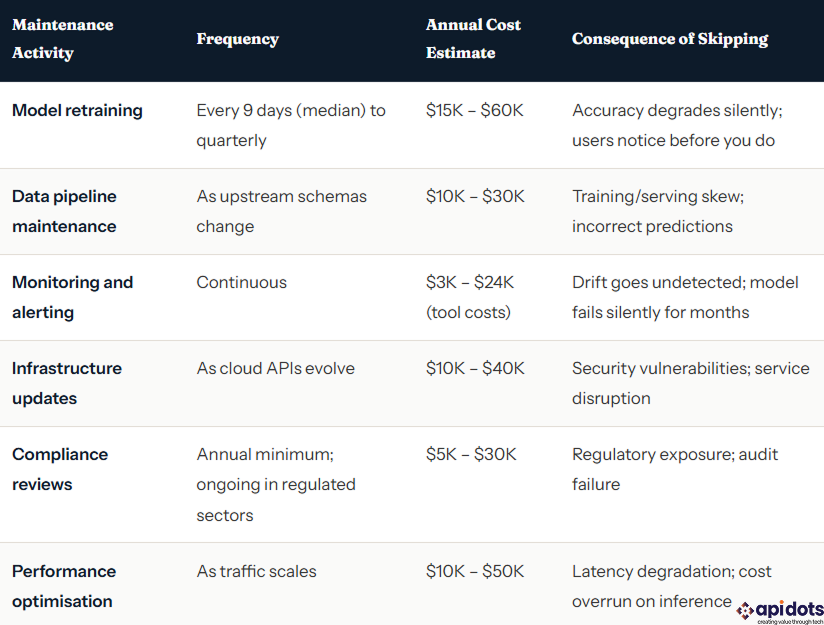
The 3-year cost rule: Take your initial build cost. Add 20% for year-one post-launch costs. Then add 15 to 25% annually for years two and three. That is your real AI software development cost over a typical evaluation horizon. A $200,000 build becomes $460,000 to $530,000 over three years. Budget for the system, not just the build.
Different AI applications have fundamentally different cost profiles. Here is a practical breakdown of the most common AI use cases businesses build in 2026, with real cost ranges that reflect current market conditions.
Build Cost: $30K – $150K
Timeline: 6–12 weeks
Primary Cost Drivers: NLP integration, guardrail architecture, CRM integration
AI chatbots are one of the fastest AI features to deploy, especially when built on pre-trained models. Costs increase with deeper CRM integration and stricter response control (guardrails).
Build Cost: $80K – $400K
Timeline: 12–20 weeks
Primary Cost Drivers: Real-time infrastructure, labeled transaction data, compliance explainability
Fraud detection requires real-time decision-making and regulatory transparency, which significantly increases both engineering and infrastructure costs.
Build Cost: $60K – $300K
Timeline: 10–18 weeks
Primary Cost Drivers: User behavior data pipeline, cold-start problem, A/B testing
The biggest challenge here is not the model—it’s building a reliable data pipeline and continuously optimizing recommendations through experimentation.
Build Cost: $40K – $180K
Timeline: 8–14 weeks
Primary Cost Drivers: Feature engineering, historical data quality, KPI alignment
This is one of the highest ROI AI use cases. Costs depend heavily on how clean and structured your historical data is.
Build Cost: $50K – $250K
Timeline: 10–16 weeks
Primary Cost Drivers: Document processing pipeline, extraction accuracy, human review workflows
Accuracy is critical here. Many systems require human-in-the-loop validation, which adds both complexity and cost.
Build Cost: $80K – $350K
Timeline: 12–20 weeks
Primary Cost Drivers: Labeled image datasets, real-time inference
Data collection and labeling are often the most expensive part. Production environments (like manufacturing lines) also require high-speed inference.
Build Cost: $20K – $100K
Timeline: 6–10 weeks
Primary Cost Drivers: LLM fine-tuning, IDE integration, security review
These systems are relatively quick to build but require careful security validation—especially when interacting with proprietary codebases.
Build Cost: $40K – $300K
Timeline: 10–20 weeks
Primary Cost Drivers: Agent architecture, governance, integrations, human-in-the-loop design
Agent-based systems introduce orchestration complexity. Governance and control layers are essential to prevent unpredictable behavior.
The most consequential AI cost decision you will make is not which model to use — it is how to source the development capability. Each approach has a fundamentally different cost structure and risk profile.
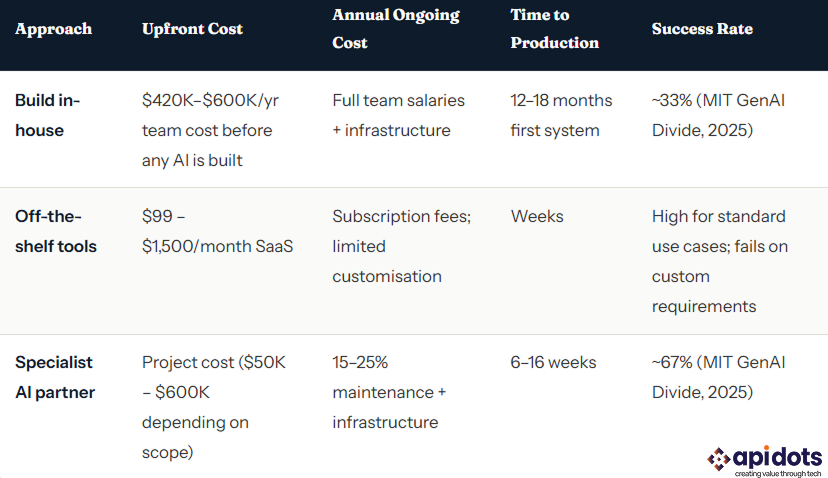
MIT’s GenAI Divide report (2025) put the data bluntly: purchasing AI tools from specialized vendors and building partnerships succeeds about 67% of the time, while internal builds succeed only one-third as often. The gap is not about talent quality — it is about the time required to build ML engineering competency, MLOps infrastructure, and production deployment experience from scratch.
Build in-house when ML is your core competitive moat, and you plan to staff a permanent team of 3 or more ML engineers long-term. For every other business — which is most businesses — partnering with a specialist delivers production systems 3 to 4 times faster at lower total cost over a three-year horizon.
Before signing any AI development contract, ask these three questions. The answers will reveal whether the proposal reflects the true cost of building and maintaining the system, or only the cost of the initial build.
What is the monthly infrastructure cost at our expected production traffic volume, modeled at 3x current projection? Any serious AI development partner should be able to model inference costs at scale before signing. If they cannot, they are either building on the wrong architecture or have not thought through the operating cost. The difference between a $200/month inference cost and a $5,000/month inference cost at scale is a decision made in the first week of architecture design.
What does the retraining pipeline look like, and what is its annual cost? This question separates partners who have delivered production AI systems from those who have built prototypes. A real production system has a documented retraining strategy — scheduled or trigger-based — with a defined engineering cadence and cost. If the proposal is silent on retraining, the system will degrade in production and require emergency remediation that costs more than building it correctly from the start.
What is included in ongoing maintenance, and what is not? Get this in writing before signing. Specifically, does maintenance include monitoring infrastructure, updating dependencies, conducting compliance reviews, and optimizing performance? Or does it only cover bug fixes on the initial build? The gap between those two definitions is often $50,000 to $100,000 per year. Every serious AI engagement should include a clearly scoped maintenance retainer with a defined scope, or a clear statement of what ongoing work is out of scope and what it will cost when you need it.
AI development in 2026 isn’t just about building a model; it’s about building a system that works reliably in the real world. While budgets can vary widely depending on scope, what consistently determines success is not how much you spend, but how well the project is planned from the start.
The highest cost and the most underestimated is data. Clean, structured, usable data often takes more effort than the model itself. On top of that, many teams overlook what happens after launch: monitoring, updates, integrations, and compliance quickly turn AI into an ongoing investment rather than a one-time build.
This is why so many AI projects exceed expectations in cost but fall short in outcomes. The gap isn’t usually technical; it’s strategic. Teams that treat AI as a full lifecycle system, rather than a feature, are the ones that see real returns.
For most businesses, the smarter approach is to start focused, validate quickly, and build toward production with the right expertise in place. Whether that means working with a specialist partner or carefully scoping an internal build, the goal is the same: create something that doesn’t just work in theory, but delivers consistent value over time.
AI development costs range from $15K (PoC) to $2M+ (enterprise platform).
Most production AI features cost $50K – $200K, while full systems range from $150K – $600K.
Data preparation is the highest cost, accounting for 30–60% of the total budget due to data cleaning, labeling, and structuring.
Hidden costs include:
These add 30–50% to the initial estimate.
Annual maintenance costs 15–25% of the initial build cost (e.g., $30K–$50K/year for a $200K system).
Outsourcing is usually cheaper.
An in-house AI team costs $420K–$590K/year, while partners deliver faster with lower total cost.
Yes. Compliance (HIPAA, finance regulations) adds 25–40% to the build cost plus ongoing overhead.
Costs stay lower with pre-trained models + focused use cases.
{ “@context”: “https://schema.org”, “@type”: “FAQPage”, “mainEntity”: [{ “@type”: “Question”, “name”: “How much does AI software development cost in 2026?”, “acceptedAnswer”: { “@type”: “Answer”, “text”: “AI development costs range from $15K (PoC) to $2M+ (enterprise platform). Most production AI features cost $50K – $200K, while full systems range from $150K – $600K.” } },{ “@type”: “Question”, “name”: “What is the most expensive part of AI development?”, “acceptedAnswer”: { “@type”: “Answer”, “text”: “Data preparation is the highest cost, accounting for 30–60% of the total budget due to data cleaning, labeling, and structuring.” } },{ “@type”: “Question”, “name”: “What are the hidden costs of AI?”, “acceptedAnswer”: { “@type”: “Answer”, “text”: “Hidden costs include: Model retraining Monitoring & drift detection Integration maintenance Compliance updates Inference scaling These add 30–50% to the initial estimate.” } },{ “@type”: “Question”, “name”: “How much does AI maintenance cost per year?”, “acceptedAnswer”: { “@type”: “Answer”, “text”: “Annual maintenance costs 15–25% of the initial build cost (e.g., $30K–$50K/year for a $200K system).” } },{ “@type”: “Question”, “name”: “Is it cheaper to build AI in-house or outsource?”, “acceptedAnswer”: { “@type”: “Answer”, “text”: “Outsourcing is usually cheaper. An in-house AI team costs $420K–$590K/year, while partners deliver faster with lower total cost.” } },{ “@type”: “Question”, “name”: “How long does AI development take?”, “acceptedAnswer”: { “@type”: “Answer”, “text”: “PoC: 4–8 weeks Single feature: 8–16 weeks Full system: 4–9 months Enterprise platform: 9–24 months” } },{ “@type”: “Question”, “name”: “Does AI cost more in regulated industries?”, “acceptedAnswer”: { “@type”: “Answer”, “text”: “Yes. Compliance (HIPAA, finance regulations) adds 25–40% to the build cost plus ongoing overhead.” } },{ “@type”: “Question”, “name”: “What is a realistic AI budget for small businesses?”, “acceptedAnswer”: { “@type”: “Answer”, “text”: “PoC: $15K – $60K Production AI: $30K – $100K Costs stay lower with pre-trained models + focused use cases.” } }] }We leverage AI, cloud, and next-gen technologies strategically.Helping businesses stay competitive in evolving markets.
Consult Technology Experts
Hi! I’m Aminah Rafaqat, a technical writer, content designer, and editor with an academic background in English Language and Literature. Thanks for taking a moment to get to know me. My work focuses on making complex information clear and accessible for B2B audiences. I’ve written extensively across several industries, including AI, SaaS, e-commerce, digital marketing, fintech, and health & fitness , with AI as the area I explore most deeply. With a foundation in linguistic precision and analytical reading, I bring a blend of technical understanding and strong language skills to every project. Over the years, I’ve collaborated with organizations across different regions, including teams here in the UAE, to create documentation that’s structured, accurate, and genuinely useful. I specialize in technical writing, content design, editing, and producing clear communication across digital and print platforms. At the core of my approach is a simple belief: when information is easy to understand, everything else becomes easier. Reach me at amysbrew.com