
Top
Search
People also search for:
Stay Inspired with Instagram




Businesses today don’t just want software—they want intelligent software. Traditional SaaS platforms that only store data or automate basic workflows are no longer enough. Companies expect predictive insights, automation, personalization, and real-time decision-making. That’s where Artificial Intelligence (AI) and Machine Learning (ML) are redefining the SaaS landscape. From AI-powered chatbots to predictive analytics engines, modern SaaS applications are embedding intelligence directly into their core architecture. According to Gartner, AI-driven software is becoming a competitive necessity rather than an innovation experiment.
In this blog, you’ll learn how AI and ML are transforming SaaS applications, key use cases driving growth, and what the future of AI-powered SaaS looks like.
AI is indeed reshaping and revolutionizing the SaaS landscape with its innovation paradigm. It offers multiple benefits to SaaS companies that are ready to innovate and adapt. Integrating artificial intelligence into SaaS development services is a big step towards growth and success. To improve productivity and bring out large-scale growth, it is imperative to incorporate AI into your SaaS. One can say, we have reached a point where there is no SaaS without AI.
AI has become a significant part of every SaaS. AI integration is a complex process where companies are facing challenges of data quality issues, and they also have fewer skilled workers. On the flip side, AI is offering a bundle of opportunities like automation, enhanced data analytics, and good customer interactions.
The current state of AI integration in B2B SaaS solutions is complex, with companies facing challenges such as data quality issues and a lack of skilled professionals. However, the opportunities presented by AI are vast, including enhanced data analysis, automated workflows, and personalized customer interactions.
AI in SaaS is a growing trend that is spreading fast across the digital world. Many established enterprises and startups are now working towards incorporating AI into their existing business models. We can’t deny the fact that AI has become a major driver of real business value. It is essential not only to adopt this disruptive technology but also to stay updated with its evolving trends. With new large language models (LLMs) emerging almost daily, it’s clear that we are part of rapid technological advancement.
Building internal AI tools is a big step that some innovative companies are taking. Startups that are focusing on AI-powered SaaS solutions will keep them ahead of the curve. Subsequently, it will become easy for them to transition to new evolving trends of AI, and hence they can adapt quickly as well. Moreover, in B2C SaaS (Business-to-Consumer Software as a Service), the churn rate is higher because every now and then, 8 to 10% of users are leaving the product owing to users’ ever-evolving demands.
The most obvious solution is to build a scalable SaaS. Startups that are already focusing on these issues and trying to figure out the solution will thrive in this tech-crunch world, where AI-powered SaaS solutions are the only way forward.

AI-powered SaaS is more effective than traditional software because it naturally adapts to changing business needs and provides smart insights. It is efficiently transforming the SaaS development services by offering multiple features that SaaS is embedding effectively into its core.
Large Language Models (LLMs) are fantastic; there’s no denying their importance. But currently, only a handful of companies are leading the way in training these models. While training LLMs is crucial, it’s just one piece of the puzzle. Looking ahead, in the next 3 to 4 years, there may be a few dozen major players training these models.
However, utilizing LLMs by SaaS companies is the smart move. SaaS companies are taking advantage of LLMs, as these models can train and power chatbots to handle complex queries 24/7. Moreover, they can also help in creating auto-generated responses, thus reducing response time. LLMs can also assist in managing large documentation and reports by automating the process efficiently.
However, what the broader world really needs is Inference; that’s where the real impact of AI will be evident. Inferencing refers to using pre-trained models (like LLMs) to actually perform tasks, automate processes, and make intelligent decisions. It’s the stage where AI is consumed, rather than developed.
For every SaaS company focused on training LLMs, there will be hundreds or even thousands more applying inference to solve business problems and deliver tangible value. That’s where the business benefits of AI are truly noticeable.
Looking to integrate AI into your SaaS platform? Our experts help build scalable, AI-enabled SaaS solutions tailored to your business needs.
Let’s explore these ideas in detail through a precise definition of each term.
In a general sense, AI and ML fall under the scope of computer science. The computer science discipline is the one in which you learn about software, operating systems, and the workings of computers.
These technologies come with unique characteristics that are taking the world by storm, redefining, transforming, and enriching the overall tech experience of consumers. AI in SaaS offers unique features that are effective in transitioning from traditional models. A few unique characteristics are mentioned below:
AI-powered new features offer personalized dashboards and content suggestions. This enhances personalization and enables companies to provide tailored experiences.
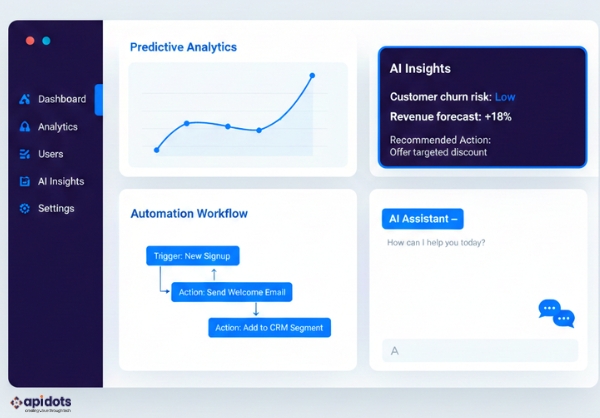
Processing of documents, categorization of data, and orchestration of workflows are some of the tedious activities that can be done by machine learning models, resulting in up to 65% reduction in manual work. It also improves the accuracy of the results and the time of completion of the tasks.
AI can predict some trends and customer churn rate by analyzing historical data. Predictive analytics helps SaaS companies to make informed decisions and stay ahead of the curve and remove technical hitches beforehand.
Creating Natural Speech with Users’ Natural Language Processing has made some of the most powerful changes in how users with SaaS applications interact with them by providing users with conversational and self-explanatory interfaces. Some of the key applications of NLP include Intelligent Chatbots and Virtual Assistants. AI conversational interfaces can be used for 24/7 customer support by answering complex queries and handling routine work. The systems also grasp the context in which they are being operated, remember the conversations that have taken place before that instance, and can also move to live agents when needed.
Data protection is the most critical concern of SaaS companies nowadays. Increasingly, SaaS companies are using AI to detect fraud and cyberattacks to provide their users with a secure environment.
NLP involves automatic extraction and categorization of unformatted text, which in turn eases the workload of document production activities as well as enhances access to data.
NLP is used by SaaS platforms to interpret the performance of the customers in terms of feedback, tickets, or social media interactions. This data helps the company measure satisfaction and focus on some areas for improvement.
Redesigning SaaS applications into AI-enabled solutions will have a significant impact, encompassing the rise of increasingly autonomous systems, highly personalized experiences, and seamlessly integrated business process enablers. The most important trends will include:
Agentic AI
Autonomous Software Agents are a priority for SaaS as they are designed to represent a software application that can set goals, make decisions, and autonomously act without any human input or approval. These agents will transform traditional SaaS architectures by replacing logic and presentation layers with intelligent decision-making capabilities.
Technical Infrastructure
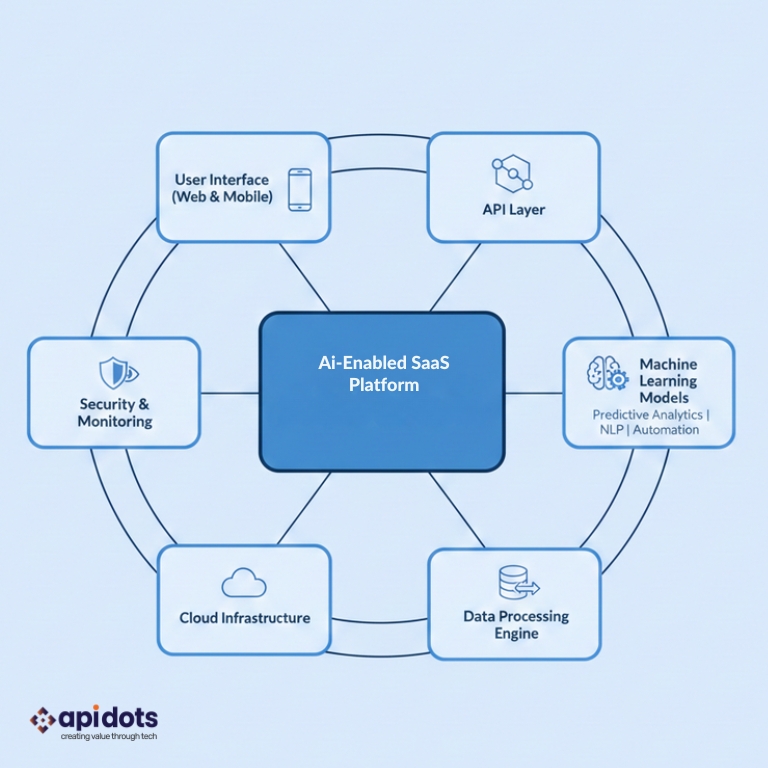
For a successful AI integration into an organization, a strong technical infrastructure is needed, which comprises cloud-native architectures, real-time data processing capabilities, and scalable machine learning pipelines. To successfully integrate such infrastructure into an organization, they need to invest in data architecture.
Autonomous Operations
AI-driven SAAS platforms can automate their work, starting from workflow planning through management of resources and even customer engagement.The integration of AI and ML in SaaS has assigned a new role to the technicians; AI and ML are the basic features (and not just an additional feature) to be ‘added on’ by SaaS developers. Essentially, SaaS applications are reaping the benefits of AI and ML by integrating these intelligent SaaS features into their core. They are making SaaS smarter and more efficient as AI-powered SaaS can predict behaviors, automate tasks, and enhance customization. Nowadays, tech is moving incredibly fast; you can ship a product on Friday, and it might already be outdated by Monday. Keeping this concern in mind, it’s vital to keep evolving SaaS development services with the new trends and keep embedding the robust technologies into its core.
Ready to transform your SaaS application with AI-driven intelligence? Explore our SaaS development services and discover how we help businesses build future-ready platforms.
1. How does AI improve SaaS applications?
AI enables predictive analytics, intelligent automation, personalization, and real-time decision-making within SaaS platforms.
2. What is the difference between AI and Machine Learning in SaaS?
AI is the broader concept of machine intelligence, while ML is a subset that enables systems to learn from data without explicit programming.
3. What is inference in AI-powered SaaS?
Inference refers to using trained AI models to perform real-world tasks like automation, recommendations, and decision-making.
4. Is AI integration expensive for SaaS companies?
Costs vary, but scalable cloud infrastructure and API-based AI services have made AI integration more accessible.
5. How does AI enhance SaaS security?
AI detects anomalies, fraud patterns, suspicious logins, and cyber threats in real time.
We engineer robust, future-ready software solutions.Built using modern architectures and proven development practices.
Hire Developers