
Top
Search
People also search for:

Stay Inspired with Instagram




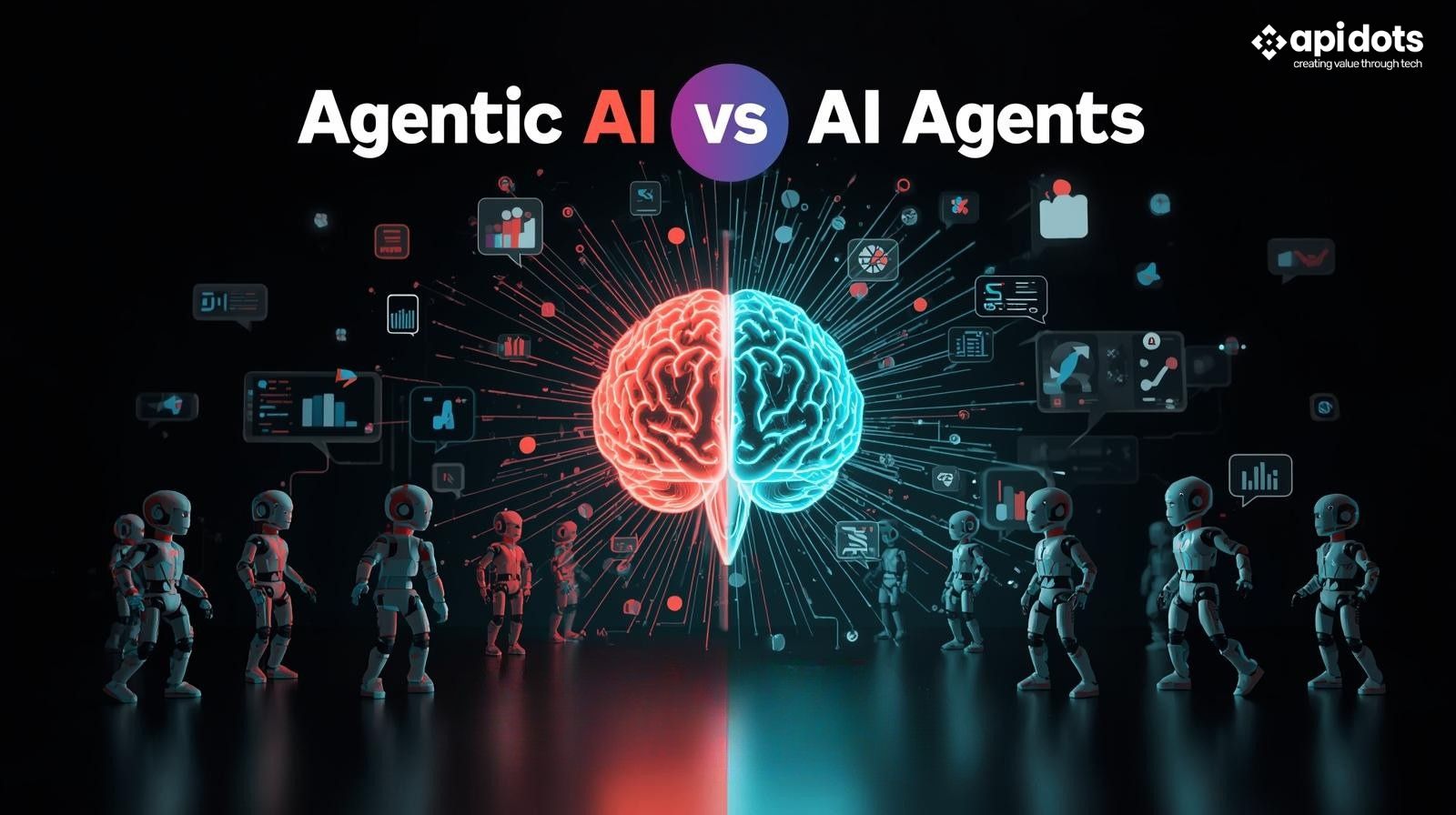
AI agents are essential for driving efficiency through task-level automation, but on their own, they don’t deliver real transformation. Agentic AI adds the missing layer of autonomy, allowing systems to reason, coordinate, and adapt across goals rather than simply follow instructions. In my view, enterprises that combine both will move beyond automation and build truly intelligent, decision-driven operations.
If your AI system still waits for instructions, you’re not transforming your business; you’re just speeding it up. That distinction matters more than most people realize. The growing conversation around AI agents and agentic AI isn’t about terminology. It’s about whether organizations are ready to move from assisted automation to autonomous decision-making.
As someone who works closely with enterprises adopting AI, I often hear leaders ask whether they should invest in Agentic AI or focus on building AI agents. On the surface, the terms sound interchangeable. In reality, they represent different stages of AI maturity and require fundamentally different approaches.
Reading John Salonen’s Agentic Artificial Intelligence: Harnessing AI Agents to Reinvent Business, Work, and Life helped me articulate something I was already seeing across enterprise environments. Organizations weren’t failing because AI agents didn’t work. They were failing because those agents lacked autonomy, shared context, and ownership of outcomes.
At their core, AI agents are software entities designed to perform a specific task or set of tasks. The CIO site puts it succinctly: AI agents are tools that
“handle a specific function within an organization’s IT systems.”
They operate within a well-defined scope and typically follow learned patterns or rules to achieve predictable outcomes. Think of a chatbot that answers HR queries, a calendar-booking assistant, or a generative-AI bot that drafts marketing copy.
According to the ISACA post, these tools respond to inputs and carry out pre-programmed actions, but
“lack agency because they don’t pursue independent goals.”
I like to describe AI agents as skilled employees: they are incredibly efficient at the job they’re designed for, but they don’t design the job itself.
Agentic AI, on the other hand, is an orchestration layer that combines multiple agents and tools into a cohesive system capable of independent reasoning and multi-step planning. After my extensive reading on Agentic AI vs AI Agents, I can simply say that agentic AI acts as the coach and playbook, coordinating multiple AI players to achieve broader objectives.
Such systems set their own goals, learn from experience, adapt to changing conditions, and decide which tools to call and in what order. Another article describes agentic AI as AI with genuine agency, capable of setting priorities, planning multi-step actions, and taking initiative without explicit human prompting.
Instead of just answering a customer’s question, an agentic system might detect patterns in support tickets, prioritize urgent issues, automate approvals, and proactively prevent future problems. This is closer to how humans operate when they own a process end-to-end.
The distinction matters because our expectations shape how we invest, design governance, and manage risk. Many organizations are rushing to adopt AI agents, and vendor marketing often blurs the line between simple agents and true agentic systems.
Without a clear understanding, companies may overpay for glorified chatbots or inadvertently give autonomous authority to tools that aren’t mature enough to handle it. The same article warns that agentic AI remains nascent – early prototypes exist, but persistent memory and tool-orchestration capabilities are still being developed.
Leaders need to question whether they truly need a fully autonomous system and how they will supervise it. In my experience, failing to make this distinction leads to unrealistic expectations and underwhelming results.
This distinction is exactly what we focus on at APIDOTS. When we work with enterprises on AI-driven transformation, the conversation rarely starts with tools. It starts with intent, like what decisions can be delegated, what outcomes need ownership, and where autonomy actually adds value.
AI agents solve execution problems. Agentic AI solves coordination and decision problems. Our role is to help organizations design the right balance between the two.
I see this mistake everywhere: people using Agentic AI and AI Agents as if they mean the same thing. They don’t. And that misunderstanding is quietly slowing down digital transformation. AI agents are execution-focused. They are designed to carry out clearly defined tasks, follow structured workflows, and respond to instructions within fixed boundaries. They are excellent at automation, efficiency, and scale.
Agentic AI operates at a different level entirely. It is not just about doing tasks but about deciding which tasks matter. It can reason across goals, adapt its approach, and orchestrate multiple AI agents to achieve outcomes rather than outputs.
Recent industry discussions make it clear that we are shifting away from AI as a passive tool and toward AI as an active participant in decision-making. Treating agentic AI as “just another agent” misses the point. One automates work; the other reshapes how work gets defined in the first place.
A recent survey by McKinsey underscores why it’s important to get this right. In its 2025 global AI survey, 88 % of respondents said their organizations use AI in at least one business function. However, only about one-third of companies have begun to scale AI programs across the enterprise.
When it comes to agentic AI specifically, just 23 % of respondents said they are scaling an agentic system somewhere in their organization, while 39 % are experimenting with AI agents. That means the majority of enterprises are still in pilot mode.
This statistic matters because it shows that agentic AI isn’t mainstream yet and reinforces the idea that AI agents are the building blocks on which agentic systems will be built.
In my view, the survey shows that both are vital: AI agents provide tangible value today, while agentic AI represents the next phase of transformation.
Several recent articles have sparked debate about how these concepts should be used.
As someone working in this space, I find the conversation healthy. The cautionary tales remind us to avoid hype, while the optimistic views help us imagine the potential. Together, they push the industry toward mature, accountable solutions.
I don’t believe this is an either-or debate. AI agents and agentic AI serve different purposes, and digital transformation collapses without both. AI agents are what make transformation practical today. They reduce operational friction, automate repetitive processes, and deliver immediate ROI.
Without them, organizations stay stuck in manual execution and never reach scale.But relying only on AI agents leads to a ceiling. This is where agentic AI becomes critical. It turns isolated automations into intelligent systems that can adapt, prioritize, and improve over time.
A recent McKinsey Global Survey shows that 23% of organizations are already scaling agentic AI systems, which tells me this shift is no longer experimental.
My view is straightforward: AI agents power efficiency, but agentic AI powers evolution. Companies that combine both will move faster, think smarter, and redefine how digital transformation actually works.
I’m convinced that digital transformation requires both AI agents and agentic AI – but at different levels of maturity.
The debate over agentic AI versus AI agents is not a binary choice; it’s a continuum. AI agents are the building blocks that deliver value by automating discrete tasks. Agentic AI is the emerging orchestration layer that promises to transform entire workflows by combining multiple agents, reasoning across domains, and acting independently.
Recent discussions highlight both the excitement and the caution around these technologies, and a credible survey shows that only a minority of organizations have scaled agentic systems while most are still experimenting.
My advice is to invest in AI agents now to build capability and data pipelines, while preparing for agentic AI by improving governance, data readiness, and cross-agent orchestration. By understanding the difference and embracing both stages, we can drive digital transformation in a way that is both ambitious and responsible.
If you’re exploring how AI agents and agentic AI fit into your transformation roadmap, join APIDOTS today.
We manage and optimize your IT infrastructure end-to-end.Ensuring stability, security, and operational continuity.
Consult IT Experts
Hi! I’m Aminah Rafaqat, a technical writer, content designer, and editor with an academic background in English Language and Literature. Thanks for taking a moment to get to know me. My work focuses on making complex information clear and accessible for B2B audiences. I’ve written extensively across several industries, including AI, SaaS, e-commerce, digital marketing, fintech, and health & fitness , with AI as the area I explore most deeply. With a foundation in linguistic precision and analytical reading, I bring a blend of technical understanding and strong language skills to every project. Over the years, I’ve collaborated with organizations across different regions, including teams here in the UAE, to create documentation that’s structured, accurate, and genuinely useful. I specialize in technical writing, content design, editing, and producing clear communication across digital and print platforms. At the core of my approach is a simple belief: when information is easy to understand, everything else becomes easier.