
Top
Search
People also search for:

Stay Inspired with Instagram




The landscape of e-commerce website development has changed quickly in 2025. As we step into 2026, you have more choices than ever, so determining the best technology for your online store is no longer just about what is cutting-edge technology. It is about strategic, scalable technology that is well-suited for your business.
A modern eCommerce brand thrives on a strong, robust e-commerce tech stack. This consists of an array of front end frameworks (like React or Vue.js), back-end engines (like Node.js, Laravel, or Python), and secure database technology (like MySQL, MongoDB, or PostgreSQL) that allows brands to create an engaging experience designed to provide fast-loading and mobile-friendly shopping experiences that drive conversions.
In the blog, you will learn: which tech stacks matter, how to determine the best tech stacks for your needs, what you might have to trade off based on all potentials, and how to build to win for your eCommerce website.
Let’s start with some context. Global e-commerce sales are projected to reach US $6.86 trillion in 2025, up approximately 8.3% year-over-year. In the U.S., one estimate predicts retail e-commerce will reach US $1.47 trillion by 2025.
What does that mean? It means that every second your store is slow, buggy, or limited by its technology, you’re losing a real opportunity. The tech you choose isn’t just background plumbing—it’s a growth lever.
Here’s a helpful analogy: think of your eCommerce website like a race car. The engine (the technology stack) and the chassis (user experience) must be tuned together. If you pick a great engine but the chassis can’t handle speed, you crash. Similarly, if you pick a flashy theme but the backend is weak, you’ll hit performance bottlenecks.
When you ask “Which technology is best?” you’ll generally be choosing among three broad models:
For startups and lean teams, this can be the fastest path. Platforms like Shopify or BigCommerce provide out-of-the-box features, including catalog management, payments, and hosting. Less setup means faster go-live. But the trade-off is less custom control and potentially higher long-term subscription costs.
If you anticipate complex customizations (unique checkout flows, niche integrations, large inventory), open-source (e.g., Magento/Adobe Commerce) offers flexibility. You manage hosting, updates, and security. More overhead but more freedom.
This is the premium option—where the front-end (customer-facing interface) is decoupled from the back-end commerce engine via APIs. According to Wikipedia, “headless” means the “front-end (head) is decoupled from the back-end commerce functionality,” so you can deliver across channels (mobile app, web, kiosk) without rewiring your commerce engine.
Best suited for those with omnichannel ambitions, high traffic, and a need for maximum flexibility. But it comes with complexity and cost.
Now that you understand the models, what should guide your decision? Here are five critical factors to evaluate:
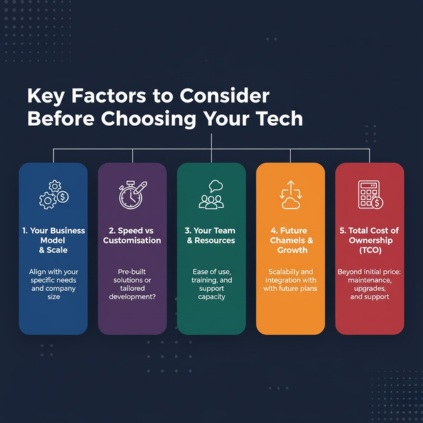
Are you a niche DTC startup with 100 SKUs or a multi-channel enterprise planning thousands of SKUs and international sales? If it’s simpler, SaaS may be the better choice. If complexity is on the horizon, invest wisely.
Need to launch quickly? SaaS reduces time-to-market. Need a unique user experience? Then open-source or headless may be required.
Do you have in-house developers or rely on agencies? More flexibility means more maintenance costs.
Mobile commerce is rising. Some estimates suggest that nearly half of U.S. e-commerce sales will be mobile by 2027.
Sometimes, open-source software may appear to be inexpensive, but you’ll ultimately pay for hosting, updates, and security. SaaS has subscription costs but includes a range of managed services. Budget accordingly.
Let’s explore what’s new. What’s changing this year in technology that should influence your choice?
In 2025, ~77.2% of e-commerce professionals report using AI/automation in their roles (up from ~69.3% in 2024). Your tech stack needs to support personalization, recommendations, and dynamic pricing. If your platform locks you out of customizing these, you’re limited in your options.
Another trend: successful brands aren’t piling on 20 apps—they’re choosing fewer, smarter integrated tools. As one study puts it, “integration and compatibility are a must” in 2026.
A headless/composable architecture supports app-like experiences and future-proofing.
Social commerce, mobile checkout, and buy-online-pick-up-in-store (BOPIS) will become more prevalent. When choosing your technology, you should not hold yourself to a web-only experience, but instead, set your technology up to support a seamless omnichannel experience.
Consumers expect fast sites and secure payment experiences to advance. According to the official WebAndCrafts website, digital wallets accounted for ~53% of online transactions globally in 2025.
Your stack must support modern payment rails and high performance.
Let’s look at real examples:
You’re launching a DTC fashion label with 200 SKUs, focusing on the U.S. only. Go with a SaaS platform (e.g., Shopify). Quick launch, manageable cost. Later, you can migrate if needed.
Perhaps you’re an enterprise brand planning international expansion, managing complex inventory, and implementing custom checkout. Consider open-source solutions (e.g., Magento) or SaaS platforms with custom modules. Full control matters.
If you’re a Walmart-level (or similar) company with apps, kiosks, IoT, personalization, and global markets, headless architecture is your best bet. It supports flexibility, speed, and multi-channel. But the budget must reflect the complexity.
There’s no one “best” technology for every eCommerce website, but there is the right one for your business. As you enter 2026, the smart choice comes down to aligning your business model, growth ambitions, team readiness, and budget.
Assess your goals today and pick your technology stack with foresight, not just convenience. The right foundation now will fuel your store’s success for years to come. Start your e-commerce website development journey today with Apidots.
Frequently Asked Questions (FAQ)
Q: Is Shopify always the best choice for e-commerce?
A: Not always. Shopify is great for speed and mid-market, but if you have complex workflows or enterprise needs, another stack (open-source or headless) may serve you better.
Q: What is headless commerce, and is it worth it?
A: Headless commerce decouples the front-end from the back-end via APIs, allowing more flexible presentation layers. It’s worth it if you have multi-channel, high-volume or global ambitions—but it’s more complex and costly.
Q: How do I decide between SaaS and open-source?
A: Evaluate your launch speed, customisation needs, control vs cost, and long-term growth plan. Use the checklist in Section 3 for alignment.
Q: How much should I budget for an eCommerce tech stack in 2025?
A: Many eCommerce professionals spend between US $5,000 and US $50,000 annually for their tech stack. Larger enterprises spend significantly more, depending on scale and customization.
We engineer robust, future-ready software solutions.Built using modern architectures and proven development practices.
Hire Developers
Hi! I’m Aminah Rafaqat, a technical writer, content designer, and editor with an academic background in English Language and Literature. Thanks for taking a moment to get to know me. My work focuses on making complex information clear and accessible for B2B audiences. I’ve written extensively across several industries, including AI, SaaS, e-commerce, digital marketing, fintech, and health & fitness , with AI as the area I explore most deeply. With a foundation in linguistic precision and analytical reading, I bring a blend of technical understanding and strong language skills to every project. Over the years, I’ve collaborated with organizations across different regions, including teams here in the UAE, to create documentation that’s structured, accurate, and genuinely useful. I specialize in technical writing, content design, editing, and producing clear communication across digital and print platforms. At the core of my approach is a simple belief: when information is easy to understand, everything else becomes easier. Reach me at amysbrew.com