
Top
Search
People also search for:
Stay Inspired with Instagram




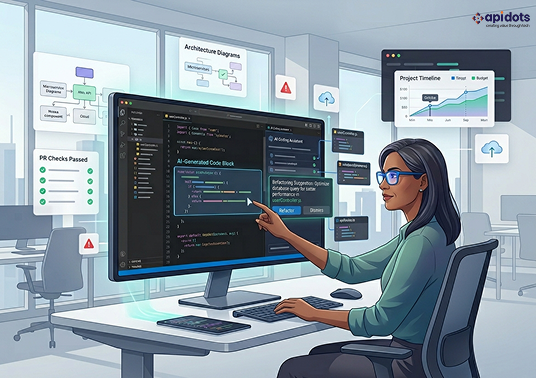
AI tools for software development are now standard for modern engineering teams in 2026. What that means for how code gets written, who businesses hire to write it, and what leaders need to understand before their next build decision.
The debate about whether AI in software development would replace developers has quietly ended. Not because one side won, but because the question stopped being useful. In 2026, AI tools for software development are not replacing engineers. They are splitting them into two groups: those who use AI to multiply their output, and those who do not. The gap between those two groups is widening fast.
For founders, CTOs, and product leaders, this shift creates a set of decisions that most standard hiring frameworks were not built for. The questions are no longer theoretical. Should your next build use a smaller team with AI-native engineers? When does AI in software development reduce project cost, and when does it create risk? What does a strong AI development company look like in 2026 versus one that claims AI fluency but delivers at 2023 speeds?
This guide answers those questions directly, with data from the teams and researchers who have measured what is actually changing on the ground.
Two years ago, AI coding tools were autocomplete with better suggestions. They finished lines, proposed function signatures, and occasionally drafted a short utility function. Useful, but incremental. The category was called “AI copilots” for a reason: humans still wrote every meaningful line.
That category no longer describes what the best AI software development tools do in 2026. The shift is from completion to creation, and from single-file suggestions to multi-file, multi-step execution.
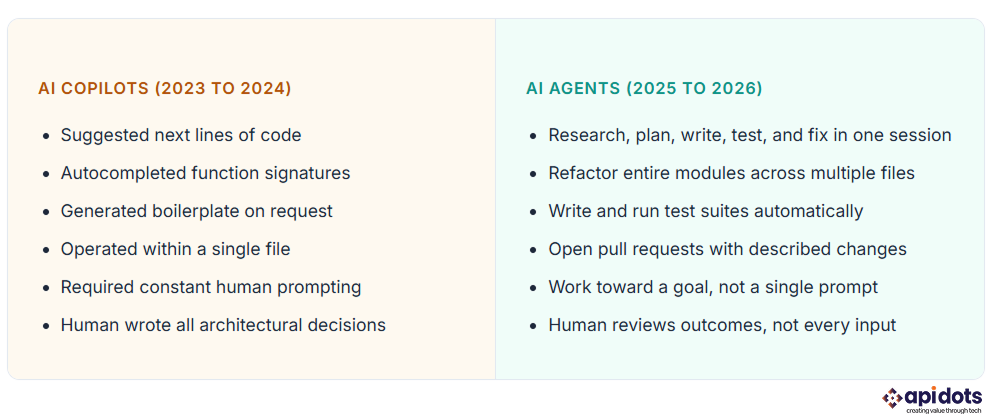
According to Lycore’s 2026 outsourcing analysis, in Q1 2025, 34% of AI coding sessions involved multi-file edits. By Q1 2026, that figure reached 78%. The scope of what a single developer session can accomplish has expanded dramatically. Understanding AI coding workflows is no longer optional for engineering teams that want to stay competitive.
The shift that matters for business leadersThe move from copilots to agents changes the bottleneck in software development. It used to be typing speed and individual coding capacity. Now the bottleneck is architectural judgment and the ability to evaluate AI-generated output. Senior engineers who can do both have become the scarcest resource in the market.
The market for AI tools for software development has consolidated significantly since the crowded field of 2024. Three tools now dominate actual usage among professional developers, with a second tier of specialized tools filling specific workflow gaps.
| Tool | Primary Use Case | Best Fit | Market Position | Pricing (per seat) |
|---|---|---|---|---|
| Claude Code | Agentic coding, full codebase refactoring, complex reasoning | Senior engineers, complex projects, startups | #1 most loved | $20 to $100/mo |
| GitHub Copilot | IDE-embedded daily coding, enterprise workflows | Large enterprises on Microsoft stack | 37% market share | $19 to $39/mo |
| Cursor | Chat-driven development, full codebase context | Product engineers, full-stack teams | Growing fast | $20/mo |
| Amazon Q Developer | AWS-native development, cloud infrastructure code | Teams on AWS stack | Specialist | $19/mo |
| Gemini Code Assist | Google Cloud integration, enterprise scale | GCP-native teams | Specialist | $19/mo |
The most significant market movement of the past year has been Claude Code’s rise. According to The Pragmatic Engineer’s 2026 AI tooling survey, Claude Code went from zero to the most-used AI coding tool in eight months, and is now rated the most loved tool by 46% of respondents, far ahead of Cursor at 19% and GitHub Copilot at 9%.
The pattern is clear: enterprise procurement still defaults to GitHub Copilot because of Microsoft’s integration and IT governance tools. Engineers who choose their own tools default to Claude Code and Cursor because they produce better output on complex tasks. These two markets are operating on different logic, and both matter depending on what kind of team you are building or hiring.
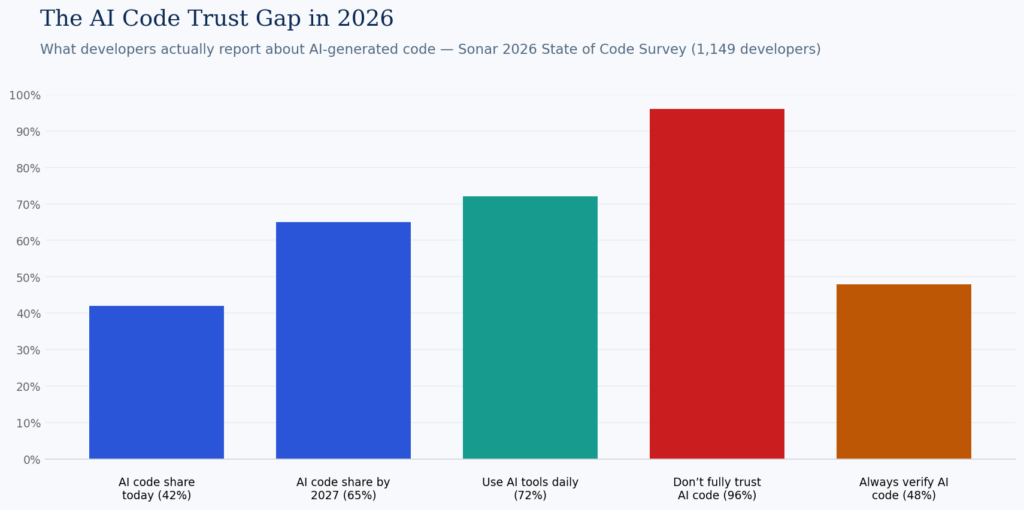
Source: Sonar 2026 State of Code Developer Survey, published January 8, 2026 (1,149 professional developers globally). All five data points are taken directly from that report. AI-generated code now represents 42% of all committed code and is projected to reach 65% by 2027 — yet 96% of developers do not fully trust it to be functionally correct, and only 48% say they always verify it before committing.
The cost and timeline impact of AI software development solutions is real but not uniform. It depends almost entirely on the experience level of the team using the tools and the complexity of what is being built.
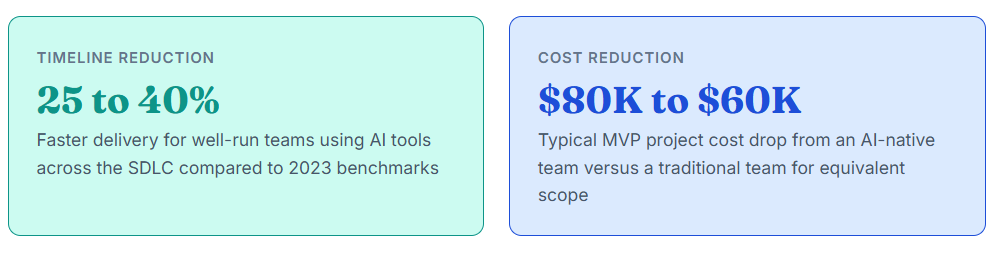
The breakdown matters. AI tools accelerate roughly 60% of software development: the mechanical work of writing standard functions, generating boilerplate, creating test cases, writing documentation, and handling repetitive refactoring. The remaining 40% still requires experienced human judgment: understanding the business problem, designing architecture, making product decisions, and catching the categories of bugs that AI generates confidently and silently.
| Project Type | Traditional Team (2023) | AI-Native Team (2026) | Time Saved | Cost Impact |
|---|---|---|---|---|
| Simple MVP | 10 to 14 weeks | 6 to 9 weeks | 35 to 40% | $80K to $55K |
| Medium SaaS platform | 5 to 7 months | 3 to 5 months | 30% | $250K to $175K |
| Complex enterprise platform | 9 to 14 months | 6 to 10 months | 25% | $600K to $450K |
| AI-native product (ML core) | N/A in 2023 | 4 to 8 months | New category | $150K to $400K |
The hiring market for software engineers has not collapsed in the face of AI. It has repriced. According to LinkedIn’s 2025 Workforce Report, job postings mentioning AI coding tool experience grew 40% year-over-year, with AI skills now appearing in 42% of software engineering job descriptions, up from just 8% in 2022. The Indeed Hiring Lab’s January 2026 Labor Market Update confirms the pattern: overall tech hiring is flat, but roles tied to AI skills are growing while general implementation roles face declining demand.
The market is not hiring fewer developers. It is hiring a different kind of developer, for different reasons, at different compensation levels. For any business building a product in 2026, understanding this shift changes who you look for and what you pay.
For businesses hiring a development partner rather than building an internal team, this shift matters in a specific way. Tech jobs AI cannot replace are concentrated at the architecture, strategy, and systems engineering level. An AI development company worth working with in 2026 has these profiles on your account, not just developers using AI APIs.
The most important number in the entire AI coding landscape is not adoption rate. It is this: according to SonarSource’s 2026 State of Code Report, 96% of developers do not trust AI-generated code without manual review.
That figure has held steady even as AI tool capability has improved dramatically. And it explains something counterintuitive that is happening in the market right now: companies that laid off experienced engineers in 2024 to cut costs are quietly rehiring them in 2026. Not because AI tools failed, but because the teams left behind after those layoffs did not have the judgment to evaluate what the AI was producing.
As one engineering manager described the pattern: AI tools speed up output but slow down ownership. A junior developer using AI produces more code faster, but produces code they do not fully understand and cannot fully maintain. For companies, that translates into rising costs on the other side of launch, in debugging, refactoring, and system reliability.
What this means for your next build decision: If you are evaluating a development agency or considering building internally, the question is not whether the team uses AI tools. In 2026, a team that does not use AI tools is leaving 30 to 40% of its productivity on the table. The question is whether the team has the engineering depth to verify the outputs of those tools. Please ask about their code review process, not their tool stack. The tool stack is table stakes. The review culture is the differentiator.
Addressing debugging AI-generated code systematically is now a core engineering practice, not an edge case. The best development teams have built this into their standard workflow. The weakest teams have not, and the consequences are showing up in maintenance costs 12 to 18 months after shipping.
Given everything above, here are the three questions that separate development partners who have genuinely integrated AI tools from those who use them as marketing language:
1. What percentage of your code is AI-generated, and what is your review process for that code? A team without a clear answer to the second part of that question is shipping AI output without adequate verification. Any number for the first part is fine. No process for the second part is not.
2. How has your team composition changed in the last 12 months as a result of AI tools? A team that has genuinely adapted to AI will have a clear answer: fewer pure implementation roles, stronger emphasis on senior engineering judgment, more time spent on architecture and review. A team that has not genuinely adapted will give you a vague answer about using Copilot.
3. Can you show me a project where AI tools created a problem in production, and how you found it? Every experienced team has this story. The answer tells you whether they have a real code review culture or a performative one. For more on vetting a development partner thoroughly, see the full guide on choosing an AI development company.
For a complete picture of what AI-native development costs at each project scope, the AI-native software development complete breakdown covers team structures, tool costs, and the numbers that actually drive project budgets in 2026.
API DOTS builds AI-native software systems for businesses in healthcare, finance, SaaS, and manufacturing. Book a free 30-minute call and we will tell you honestly whether AI tools can compress your timeline, what the real cost looks like, and which parts of your build still require experienced human judgment.
No. AI is not replacing software developers as a category. What AI tools are replacing are specific tasks within development, such as routine coding, boilerplate generation, and basic test writing.
The roles growing fastest are those that require architectural judgment, code review, and the ability to evaluate AI-generated output. Developers most at risk are not developers in general, but those who have not adapted to working with AI tools.
For well-run teams with strong code review practices, AI tools can reduce project timelines by 25% to 40%, depending on project complexity.
Simple MVPs usually see the largest gains, around 35% to 40% faster, because more of the work is mechanical coding. Complex enterprise platforms see smaller gains, around 25%, because architecture, system design, and business logic still require experienced human judgment.
The most valuable combination is technical depth, AI tool fluency, and strong code review discipline.
Businesses should look for developers who can explain how they review AI-generated code, not just which tools they use. A good question to ask is: “Can you describe a time when AI generated plausible but incorrect code, and how you caught it?”
Yes, but only when the development partner has the right team composition.
For example, a project that may have cost around $80,000 in 2023 could now cost roughly $55,000 to $65,000 with an AI-native team of experienced engineers. The savings come from reducing time spent on mechanical coding tasks.
However, cheap AI-assisted development from junior-heavy teams can create higher maintenance costs after launch. The better comparison is total cost of ownership over 18 to 24 months, not just the initial build cost.
AI software development tools are products engineers use to write code faster, such as GitHub Copilot, Cursor, Claude Code, and similar platforms.
AI software development services are end-to-end delivery capabilities provided by a development company. These services may include architecture, data pipelines, model deployment, application development, integrations, and ongoing maintenance.
Tools are inputs. Services are the complete capability a business buys when it does not have that team internally.
The volume of AI software development news has created a gap between what businesses believe AI can do and what production systems actually deliver.
Many companies enter vendor conversations with expectations shaped by demos and press releases rather than real deployment experience. This often creates scope misalignment, where buyers expect heavy automation, while vendors still need significant human oversight to deliver a reliable product.
Business leaders should understand three things:
First, AI tool adoption is now table stakes. Any serious development team should already be using AI tools.
Second, code review culture matters more than the tool stack. The key question is how the team evaluates and verifies AI-generated output.
Third, senior engineering judgment has become more valuable, not less. The best partner is not simply the team that writes code fastest, but the team that can tell the difference between code that truly works and code that only appears to work.
We build and deploy end-to-end AI software solutions for businesses. Accelerating efficiency, automation, and intelligent decision-making.
Get AI Development Services
Hi! I’m Aminah Rafaqat, a technical writer, content designer, and editor with an academic background in English Language and Literature. Thanks for taking a moment to get to know me. My work focuses on making complex information clear and accessible for B2B audiences. I’ve written extensively across several industries, including AI, SaaS, e-commerce, digital marketing, fintech, and health & fitness , with AI as the area I explore most deeply. With a foundation in linguistic precision and analytical reading, I bring a blend of technical understanding and strong language skills to every project. Over the years, I’ve collaborated with organizations across different regions, including teams here in the UAE, to create documentation that’s structured, accurate, and genuinely useful. I specialize in technical writing, content design, editing, and producing clear communication across digital and print platforms. At the core of my approach is a simple belief: when information is easy to understand, everything else becomes easier. Reach me at amysbrew.com