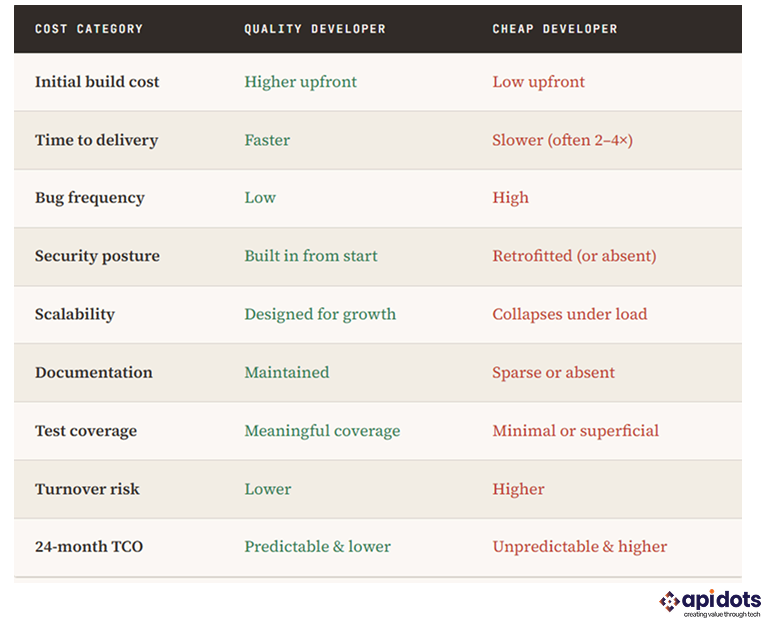
Lower upfront cost often leads to higher total cost due to compounding inefficiencies
Quality compounds (and so does poor code): good architecture accelerates development, bad code slows it exponentially
Speed is driven by expertise, not hourly rate: skilled developers reduce time-to-market and improve outcomes
Hidden risks outweigh visible savings: bugs, security flaws, and downtime create an exponential impact
Optimize for long-term systems, not short-term output: scalable, maintainable software is more valuable than quick feature delivery
Hiring below-market-rate talent feels like smart budgeting. In reality, it is one of the most expensive decisions a business can make, and the bill arrives later, when it hurts most.
Every founder, product manager, and procurement officer has been tempted. The $15/hour developer versus the $150/hour one. On a spreadsheet, it’s 90% savings. In practice, it is often a 300% cost overrun, months of delay, and a codebase someone else will eventually have to burn down and rebuild from scratch.
This is not a snobby argument for overpaying. There are genuinely talented developers working at every price point. But the market for software talent, like most skilled labor markets, is broadly efficient. When someone offers development services at dramatically below-market rates, something is being sacrificed, and the question is simply what, and when will you find out? Knowing how to evaluate a software development company before you commit is the first line of defence.
The answer to both is almost always: more than you expected, and at the worst possible moment. This blog documents exactly why, covering every cost dimension that arises when quality is traded for rate.
The Illusion of the Low Hourly Rate
The first mistake is evaluating developer cost by the hour rather than by the outcome. A developer charging $20/hour who takes 300 hours to build a feature costs $6,000. A developer charging $80/hour who completes the same feature in 40 hours costs $3,200 and delivers a solution that is maintainable, tested, and documented.
But the hourly comparison isn’t even the most dangerous part. The real costs of cheap development are almost never visible on an invoice. They appear months later, in the form of missed deadlines, catastrophic bugs, security breaches, and the astronomical expense of rebuilding what was built wrong the first time.
Let me be more concrete. When you hire a below-market developer, you are not simply getting the same work at a discount. You are making a trade-off of short-term cash savings for several categories of deferred costs. Each of those categories is a compound. And unlike the initial savings, which are capped, the deferred costs are not.
The Twelve Real Costs Examined Honestly
Technical Debt: Technical debt is the accumulation of shortcuts, anti-patterns, and architectural mistakes that make future changes slower and more error-prone. Every experienced developer takes some shortcuts; the discipline is knowing which are acceptable and which are mortgaging your future. Inexperienced or under-resourced developers rarely have this judgment. They write code that works today and becomes a liability tomorrow. Functions that do twelve things, variables named x, dependencies tangled so tightly that changing anything risks breaking everything else. Each new feature takes longer to build than the last because the developer must first fight the existing code. Speed drops. Time-to-market suffers. And eventually, the debt demands a full rewrite, priced, typically, at 2 to 5 times the cost of building it correctly the first time.
Slower Delivery: Speed and rate are inversely related in software far more than in most industries. A senior developer solving a problem they have seen before can be 10 to 20 times faster than a junior one encountering it for the first time. This is not an exaggeration; it is documented in decades of software engineering research going back to DeMarco and Lister’s Peopleware. If you are hiring mobile developers, the questions you ask upfront directly determine the speed you get. The result: the developer who costs 80% less will often deliver in three to four times as long. He will slip deadlines. Launches are delayed. Revenue is deferred. Competitors move. The opportunity cost of delay is rarely factored into the initial hiring calculation, but in competitive markets, it is frequently the most expensive cost of all.
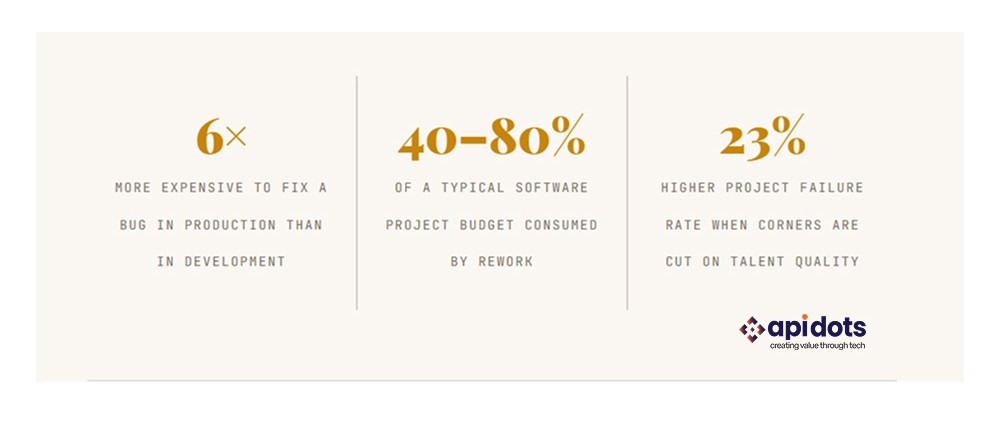
Bug Costs: The cost of a software defect multiplies dramatically the later it is caught. A bug identified during code review costs almost nothing. The same bug discovered in QA costs perhaps $500 to $2,000 to fix. In production, that number ranges from $10,000 to $100,000 when you factor in downtime, customer impact, hotfixes deployed under pressure, and the reputational damage from visible failures. Cheap developers, who typically lack the experience to write clean, testable code and often have no meaningful QA process, produce more bugs at earlier architectural layers, making them the most expensive to fix. The savings on the invoice are erased, often many times over, by the support and remediation bill.
Security Vulnerabilities: Inexperienced developers are disproportionately responsible for the most common and most devastating classes of security vulnerability: SQL injection, cross-site scripting, broken authentication, insecure direct object references, and improperly stored credentials. These are not exotic attacks; they are on the OWASP Top 10 list, meaning they are among the most well-known and well-exploited vulnerabilities. A skilled developer treats security as a design constraint from the first line of code. An under-resourced one often isn’t even aware of the attack surface they are creating. The average cost of a data breach in 2024 exceeded $4.5 million, a figure that makes any developer rate comparison look irrelevant.
Scalability Failure: Nothing illustrates the cost of cheap development more painfully than a product that fails precisely because it succeeds. Systems built without scalability in mind, without proper database indexing, without thought given to concurrency or caching, or load distribution, collapse under traffic. The product crashes exactly when it should be converting customers. This is especially devastating in SaaS product development, where traffic spikes are tied directly to growth milestones. Rebuilding for scale is expensive; losing those customers is even more expensive, because they rarely come back. Experienced architects think about scale before it is needed. This is a discipline built over years, and it is rarely present in below-market talent.
Poor Documentation and Knowledge Concentration Risk: Cheap developers, particularly freelancers chasing volume, rarely write meaningful documentation. The why of a decision is never captured. The architecture exists only in the developer’s head. When that developer leaves and takes below-market talent, turnover is high the knowledge walks out the door with them. The next developer inherits a system they cannot understand without months of archaeology. Every day of ramp-up time costs money. And because the code is undocumented, they will make wrong assumptions, break things they didn’t expect to break, and write new technical debt on top of the old. The documentation gap is one of the most underestimated compounding costs in software.
Communication Failure and Misunderstood Requirements: Experienced developers ask the right questions before they write a line of code. They probe requirements until they understand not just what is being asked for but why, and then they flag when the stated solution is unlikely to solve the underlying problem. This is enormously valuable. Understanding IT outsourcing risks helps you structure the engagement so communication gaps are caught early, not after months of misdirected work. Cheap developers, by contrast, often build exactly what was asked, even when what was asked is wrong. And in software, discovering that you built the wrong thing is extraordinarily expensive, because you still have to build the right one. The gap between what a client says they want and what they actually need is a gap that only skilled, experienced developers can reliably bridge.
Integration Issues: Modern software is almost never built in isolation. It must integrate with payment processors, CRMs, analytics platforms, third-party APIs, internal data systems, and mobile clients. These integrations are where inexperienced developers most consistently fail. They build brittle connections, hardcode credentials, lack error handling, use synchronous calls when asynchronous are required, lack retry logic, and lack webhooks. Each integration becomes a fragile dependency. When one breaks, and they all break, the cascade of failures eventually is wide and expensive. Senior developers understand integration patterns, versioning, and fallback strategies. This knowledge is not available at the lowest price point.
Testing Gaps: Automated testing, unit tests, integration tests, end-to-end tests — these are the infrastructure that allows a software system to evolve safely. Without it, every change is a gamble. You cannot refactor. You cannot update dependencies. You cannot add features with confidence that you haven’t broken something else. Writing good tests is a skill; writing tests that actually catch the things that go wrong is an art. This problem is compounded in modern teams using AI-assisted code generation, as professionals approach debugging AI code safely before shipping. Below-market developers often write no tests at all, or write tests so shallow they provide false confidence. The result is a codebase that can never be safely modified, which means it can never meaningfully grow. It is not software; it is a maintenance hostage.
Wrong Technology Choices: Technology selection has long-term consequences that last for years or decades. The wrong database engine, the wrong framework, the wrong language for the use case; these decisions define what is possible and what is prohibitively expensive for the entire lifecycle of a system. Experienced developers know when to reach for a relational database and when a document store is right; when a monolith is correct and when microservices pay for themselves; when to use an established framework and when to go light. Inexperienced developers reach for what they know, or what was popular two years ago, or what seemed easiest at the start. The architectural debt from wrong technology choices often requires complete rebuilds to escape.
High Turnover: The developers available at the lowest rates are, statistically, the most mobile. They are either very early in their careers and will leave as their market value rises, or they are freelancers for whom every project is temporary. Either way, turnover is frequent. A structured approach to software development outsourcing with proper contracts, defined ownership, and transition protocols can mitigate some of this risk, but it requires intention. Each time a developer leaves without that structure, you pay the cost of recruitment, onboarding, knowledge transfer, and the inevitable productivity dip of the replacement developer. Conservative estimates put the cost of replacing a software developer at 50-200% of their annual salary. When this happens repeatedly, as it does with cheap, high-turnover teams, the cumulative cost dwarfs any savings on the hourly rate.
Reputational Damage and Lost Customer Trust: Bad software damages brands. Users who encounter a slow, buggy, insecure, or unreliable product do not send politely worded bug reports; they leave, write reviews, and, in the age of social media, tell everyone. A single high-profile outage or data breach caused by poor code quality can undo years of brand-building and customer acquisition spending. And in regulated industries, finance, healthcare, and legal tech, poor code is not just a reputational risk; it is a compliance risk, with fines and liability that dwarf any development budget. The reputational cost of bad software is always underestimated because it is diffuse, delayed, and hard to attribute directly to a hiring decision made 18 months earlier. But the causal chain is usually clear.
The True Cost Formula
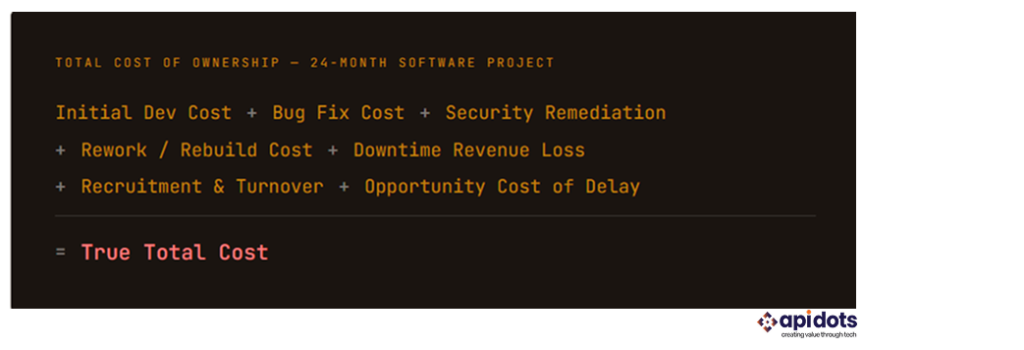
When you account for all the hidden costs, the economics of cheap development invert completely. A back-of-the-envelope framework for thinking about total development cost over a 24-month project lifecycle:
Run this calculation for a cheap development engagement and a quality one, and the cheap option almost never wins, even in the most charitable scenario. The initial invoice is lower; everything else is worse, and the everything else adds up to multiples of that initial invoice.
Run this calculation for a cheap development engagement and a quality one, and the cheap option almost never wins, even in the most charitable scenario. The initial invoice is lower; everything else is worse, and the everything else adds up to multiples of that initial invoice. If you need help estimating realistic numbers, our breakdown of custom software cost provides a structured starting point.
When Your Budget Constraints Are Real
This is not an argument that every business should hire only the most expensive developers available. Budget constraints are real. Early-stage startups have limited capital. Small businesses cannot absorb six-figure engineering salaries. The argument is not “spend more”; it is “spend smarter.”
The Right Approach
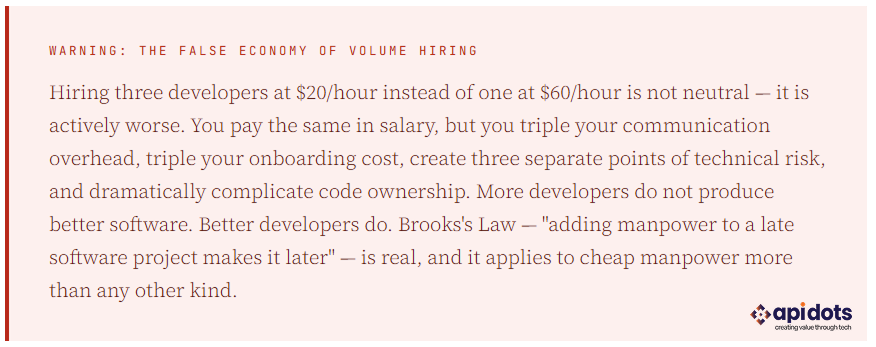
When the budget is genuinely limited, the better strategy is to hire one strong developer rather than three cheap ones to build less, but to build it right. Alternatively, well-structured offshore development teams can deliver quality at a lower cost, provided the engagement is managed with clear specs, milestone reviews, and proper code ownership. A lean, well-constructed system that does three things reliably is worth more than a sprawling system that does fifteen things badly. Scope reduction in the service of quality is a legitimate and often excellent strategic choice. Talent reduction in the service of quantity is almost never the case.
What Good Development Actually Costs and What It Buys
Understanding the cost of cheap development requires understanding what quality development actually delivers beyond the functional code itself. When you hire an experienced developer or team at market rate, you are buying the following:
Judgment. The ability to distinguish good solutions from bad ones, to push back on requirements that will create problems, and to make architectural decisions that will serve the business three years from now, not just three weeks.
Speed. True, sustained delivery velocity is not just raw typing speed, but the ability to understand a problem deeply and solve it efficiently, without creating new problems in the process.
Risk management. Proactive identification of the things that will fail before they fail, such as security vulnerabilities, performance bottlenecks, integration risks, and dependency hazards. Prevention is always cheaper than a cure.
Maintainability. Code that other developers can understand, modify, and extend, which means your system can grow as your business grows, rather than calcifying around its early limitations.
Reliability. Systems that behave predictably under load, recover gracefully from failure, and can be updated without catastrophe. This is what your customers are actually paying for, even if they never think about it.
None of these things appear on an invoice. None of them is visible in the initial months of a project. All of them determine whether your software asset appreciates or depreciates over time.
The Bottom Line
Software is not a commodity. The idea that any developer can produce any software and that the only relevant variable is price is a mistake with enormous and well-documented costs. It conflates the product with the process, the output with the quality of the thinking that produced it.
The rate you pay a developer is the smallest line item in the true cost of building software. The largest line items are all invisible until they appear, and when they appear, they are paid not in dollars drawn from a development budget, but in delays, rebuilds, lost customers, security incidents, and missed market opportunities.
Invest in quality development. Scope aggressively to match your budget. Build less if you must. But build it right because the alternative is paying two to five times as much to build it again, under pressure, with the same team that got you here.
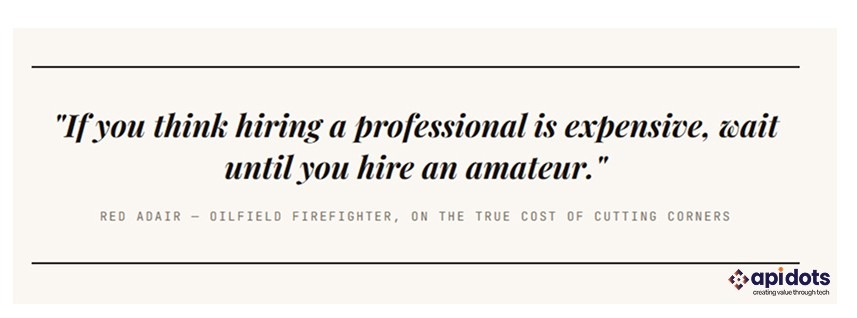
The professional who seems expensive is almost always the cheaper option. The bill for the amateur arrives later, and it is always larger.
FAQs
1. Why do cheap developers cost more in the long run? Because hidden costs like rework, bugs, delays, and rebuilds outweigh initial savings.
2. What is technical debt, and why does it matter? It’s poor-quality code that makes future changes slower, riskier, and more expensive.
3. How does developer quality impact speed? Experienced developers deliver faster and more efficiently, reducing total project time.
4. What risks come with low-cost development? Security issues, scalability failures, poor integrations, and unreliable systems.
5. What should you do if you have a limited budget? Build less but focus on quality, or hire fewer but more skilled developers.
We Develop Software Beyond Just Code Delivery
We engineer robust, future-ready software solutions.Built using modern architectures and proven development practices.
Hi! I’m Aminah Rafaqat, a technical writer, content designer, and editor with an academic background in English Language and Literature. Thanks for taking a moment to get to know me.
My work focuses on making complex information clear and accessible for B2B audiences. I’ve written extensively across several industries, including AI, SaaS, e-commerce, digital marketing, fintech, and health & fitness , with AI as the area I explore most deeply. With a foundation in linguistic precision and analytical reading, I bring a blend of technical understanding and strong language skills to every project.
Over the years, I’ve collaborated with organizations across different regions, including teams here in the UAE, to create documentation that’s structured, accurate, and genuinely useful. I specialize in technical writing, content design, editing, and producing clear communication across digital and print platforms.
At the core of my approach is a simple belief: when information is easy to understand, everything else becomes easier. Reach me at amysbrew.com







Hi! I’m Aminah Rafaqat, a technical writer, content designer, and editor with an academic background in English Language and Literature. Thanks for taking a moment to get to know me. My work focuses on making complex information clear and accessible for B2B audiences. I’ve written extensively across several industries, including AI, SaaS, e-commerce, digital marketing, fintech, and health & fitness , with AI as the area I explore most deeply. With a foundation in linguistic precision and analytical reading, I bring a blend of technical understanding and strong language skills to every project. Over the years, I’ve collaborated with organizations across different regions, including teams here in the UAE, to create documentation that’s structured, accurate, and genuinely useful. I specialize in technical writing, content design, editing, and producing clear communication across digital and print platforms. At the core of my approach is a simple belief: when information is easy to understand, everything else becomes easier. Reach me at amysbrew.com