
Top
Search
People also search for:

Stay Inspired with Instagram




“Despite $30–40 billion in enterprise investment into GenAI, this report uncovers a surprising result in that 95% of organizations are getting zero return. The outcomes are so starkly divided across both buyers (enterprises, mid-market, SMBs) and builders (startups, vendors, consultancies) that we call it the GenAI Divide. Just 5% of integrated AI pilots are extracting millions in value, while the vast majority remain stuck with no measurable P&L impact. This divide does not seem to be driven by model quality or regulation but seems to be determined by approach.” (Excerpt from Summary of State of AI in Business 2025 Report)
Most companies want to ride the wave of AI, yet they are left out of this race because of drawbacks in their AI adoption strategy mistakes. There is a GenAI divide between builders and buyers.
There is no doubt that artificial intelligence is one of the most promising technologies of our time, with AI-powered software solutions, but implementing it effectively and reaping the rewards requires strategic investment and sound guidance.
Across industries, leaders see AI as a way to boost efficiency, enhance decision-making, and drive competitive advantage through AI integration in mobile apps. According to one study, nearly every senior executive now believes AI is essential to growth and innovation.
Yet despite widespread enthusiasm, many AI initiatives fall short of expectations. A surprising number of companies spend millions on pilot projects that never translate into measurable value. Many others struggle to move beyond small proofs of concept into meaningful, scalable deployment.
The reason is not the technology itself. It is the way organizations approach AI adoption, often backwards, unfocused, or disconnected from actual business needs. In this article, we explore common mistakes companies make when adopting AI and offer practical steps to fix them.
In this blog, we will delve into seven common AI adoption mistakes and how to fix them. We will also discuss some characteristics of successful AI implementations to shorten the GenAI divide.
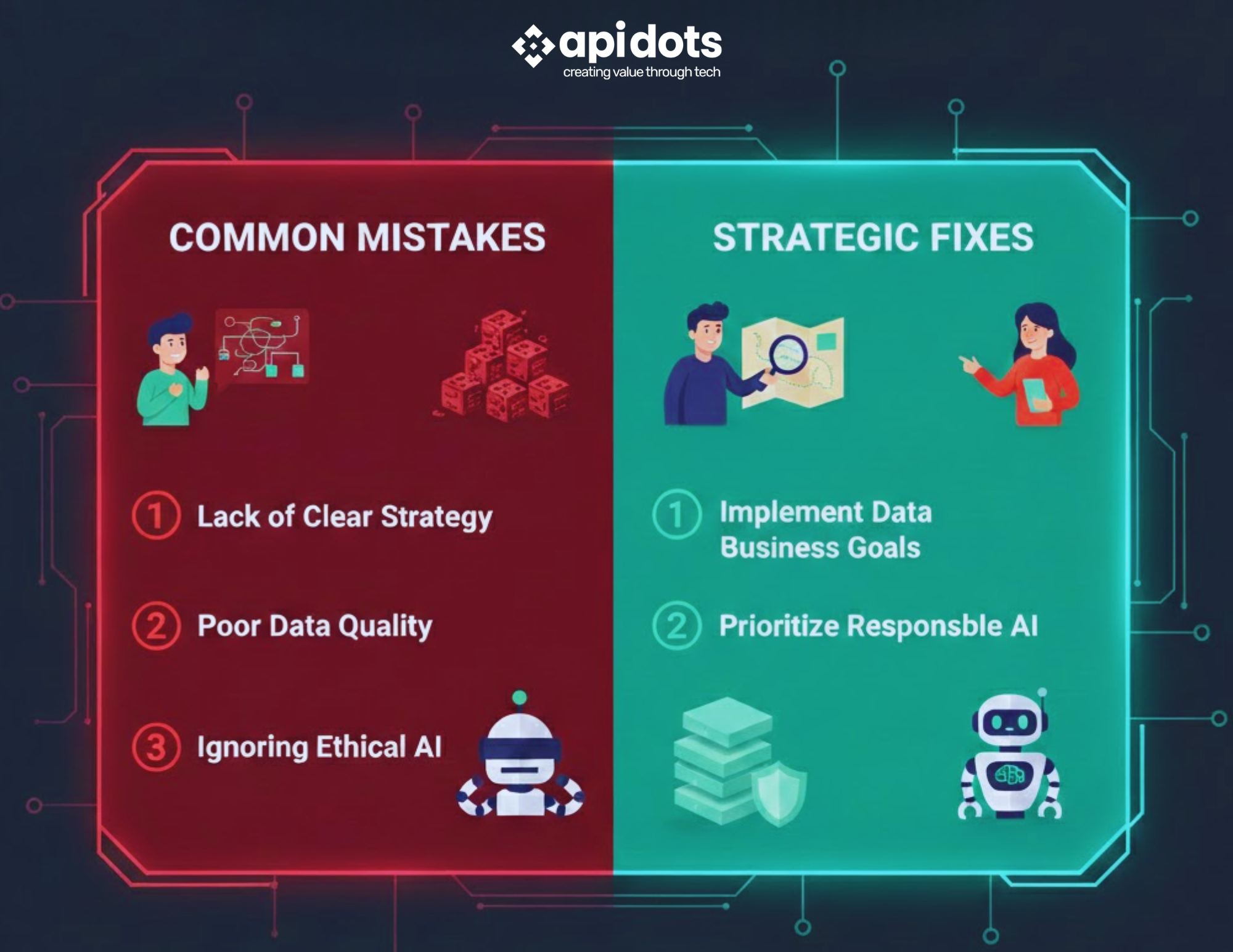
One of the most pervasive mistakes is deciding to adopt AI before identifying a real business problem it should address. Many organizations allocate budgets and resources simply because competitors do, rather than because they have a clear, measurable goal.
This “solution-first” mindset makes it difficult to assess whether the AI initiative is creating value or simply consuming resources.
Struggling to move AI pilots into real business impact? A structured AI strategy can help identify the right use cases before scaling.
How to fix it
Start with the problem, not the technology. Define a clear business objective that AI can improve, such as reducing processing time, improving forecast accuracy, or enhancing customer experience. Document the current baseline to measure improvement after AI implementation.
Another common issue is making large financial commitments too early. Driven by fear of missing out, companies often assign massive budgets before they understand where AI will deliver the most value.
This leads to pilots that never reach production because the initiative was never rooted in incremental learning or evidence-based decision-making.
How to fix it
Run small, focused pilots before scaling. Start with contained use cases that can deliver quick feedback. A three- to six-month pilot with measurable outcomes helps build confidence and reduce risk, ultimately informing larger investments.
AI systems are only as good as the data they are trained on. Poor data quality, whether incomplete, inconsistent, or poorly labeled, undermines even the best technologies. Research shows data quality issues are among the top challenges in AI adoption.
Furthermore, organizations often fail to thoroughly validate AI outputs, especially when junior staff generate code or models faster than they can be reviewed.
How to fix it
Invest in data readiness early. Assess data quality, resolve inconsistencies, and ensure governance standards are in place before building AI models. Additionally, establish robust validation processes, ideally with experienced engineers or data scientists overseeing model outputs.
Many companies view AI as purely a technical upgrade when, in reality, it requires organizational change. A Business Insider report found that adopting AI without considering employee attitudes and expectations can create internal tension and resistance.
AI adoption can trigger fear of job displacement or skepticism about its true value, slowing implementation and reducing overall impact.
How to fix it
Prioritize change management as much as technology. Communicate clearly with teams about how AI will support, not replace, human roles. Provide education and training so employees understand the benefits and limitations of AI tools.
AI is often marketed as a silver bullet, a technology that will instantly transform operations. However, the reality can be slower and more complex. Unrealistic expectations lead to disappointment and abandonment of otherwise promising projects.
How to fix it
Set realistic expectations grounded in evidence. Understand that most AI systems require iterative refinement and ongoing monitoring. Measure progress with clear performance indicators rather than vague statements of transformation.
AI tools rarely succeed in isolation. When deployed without considering how they connect with existing workflows and systems, they fail to influence decisions where it matters most. Research shows that disconnected AI pilots often become bottlenecks rather than solutions.
How to fix it
Plan for integration from the start. Ensure data flows, system compatibility, and workflow alignment are part of your adoption roadmap. Collaborate across IT, operations, and business units to build solutions that fit seamlessly into daily work. Read more….
A large body of research shows that most AI adoption challenges stem from people and processes, not from algorithms. Organizations that focus on human readiness often outperform those that concentrate solely on technology.
How to fix it
Adopt a people-first AI strategy. Involve teams early, provide ongoing learning opportunities, and create feedback loops that capture user experiences and ideas for improvement
Not every business problem is well-suited to AI. In practice, the most successful AI implementations tend to share a few common characteristics.
Many AI initiatives fail because they are built around weak or unsuitable use cases. AI is far less effective when there is little or no historical data available, when outcomes rely heavily on subjective human judgment, or when decisions carry high risk and require nuanced accountability. In these scenarios, AI may support decision-making, but it should not be relied upon as the primary decision-maker.
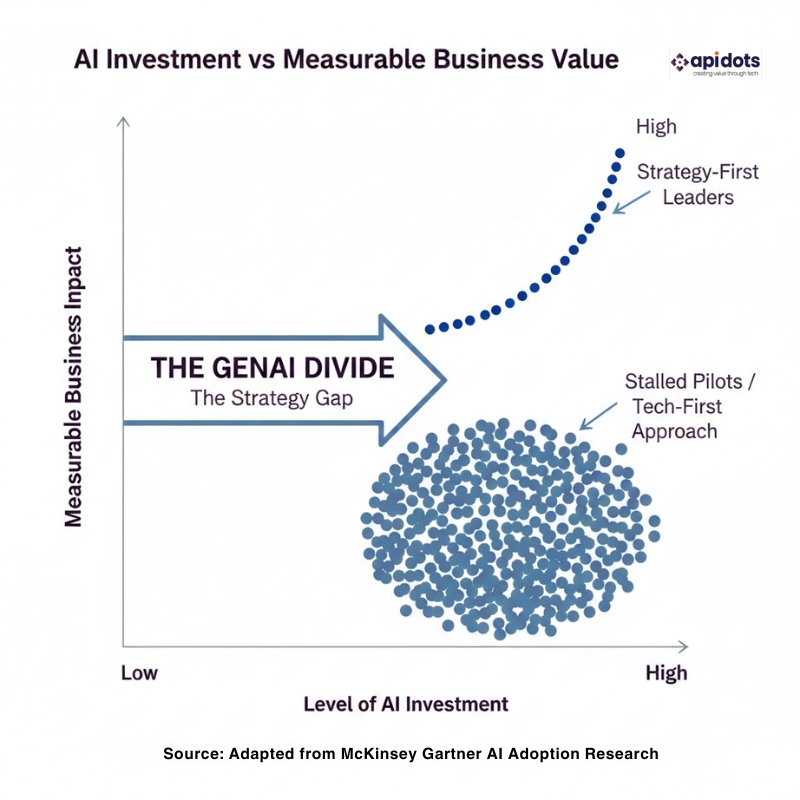
Despite increasing AI investments, most organizations struggle to convert spending into measurable business outcomes. The gap below illustrates why a strategy-first approach—not higher budgets—determines real AI success.
To shorten the GenAI divide between buyers and builders, business owners need to implement an AI adoption strategy free of the above mistakes. That way, they can reap the rewards.
AI adoption is not a technology checklist. It is a strategic transformation requiring thoughtful planning, effective execution, and alignment with real business needs. Companies that succeed with AI do so by:
When approached with discipline and clarity, AI becomes less of a risky experiment and more of a powerful engine for sustainable business value.
Ready to turn AI adoption into measurable business outcomes? Partner with APIDOTS to build a clear, scalable AI strategy aligned with real business needs.
FAQ
What does APIDOTS help with in AI adoption?
APIDOTS helps businesses define the right AI use cases, prepare data, and build scalable, production-ready AI solutions.
Can APIDOTS help if we already have AI pilots running?
Yes, we specialize in evaluating existing pilots and turning successful ones into scalable, high-impact systems.
Do you work with startups or enterprises?
We work with both startups and established enterprises, adapting AI strategies to each organization’s size and goals.
Is AI adoption only about automation?
No, AI adoption also improves decision-making, forecasting, customer experience, and operational efficiency.
How long does an AI project usually take?
Timelines vary by use case, but most projects begin with small, focused pilots before scaling into full deployment.
We leverage AI, cloud, and next-gen technologies strategically.Helping businesses stay competitive in evolving markets.
Consult Technology Experts
Hi! I’m Aminah Rafaqat, a technical writer, content designer, and editor with an academic background in English Language and Literature. Thanks for taking a moment to get to know me. My work focuses on making complex information clear and accessible for B2B audiences. I’ve written extensively across several industries, including AI, SaaS, e-commerce, digital marketing, fintech, and health & fitness , with AI as the area I explore most deeply. With a foundation in linguistic precision and analytical reading, I bring a blend of technical understanding and strong language skills to every project. Over the years, I’ve collaborated with organizations across different regions, including teams here in the UAE, to create documentation that’s structured, accurate, and genuinely useful. I specialize in technical writing, content design, editing, and producing clear communication across digital and print platforms. At the core of my approach is a simple belief: when information is easy to understand, everything else becomes easier. Reach me at amysbrew.com