
Top
Search
People also search for:

Stay Inspired with Instagram




AI is transforming industries at an unprecedented speed through AI-powered software solutions that are redefining how businesses operate.
According to the World Economic Forum’s Future of Jobs Report 2025, global trends could create 170 million new roles by 2030 while displacing 92 million, resulting in a net gain of 78 million jobs. The real shift isn’t job elimination, but skill transformation. So which high-paying careers are most resistant to automation? And what makes them durable in an AI-driven world?
In this guide, we break down AI-proof tech roles, automation-resistant careers beyond tech, and the essential human skills that will define long-term success, whether you work independently, inside a large enterprise, or alongside a custom web and app development company building the next generation of AI-powered products.
In other words, AI will change what we do, not eliminate work. This post explores which high-paying tech jobs and broad career paths are most resistant to automation, why they matter, and how to future-proof your career.
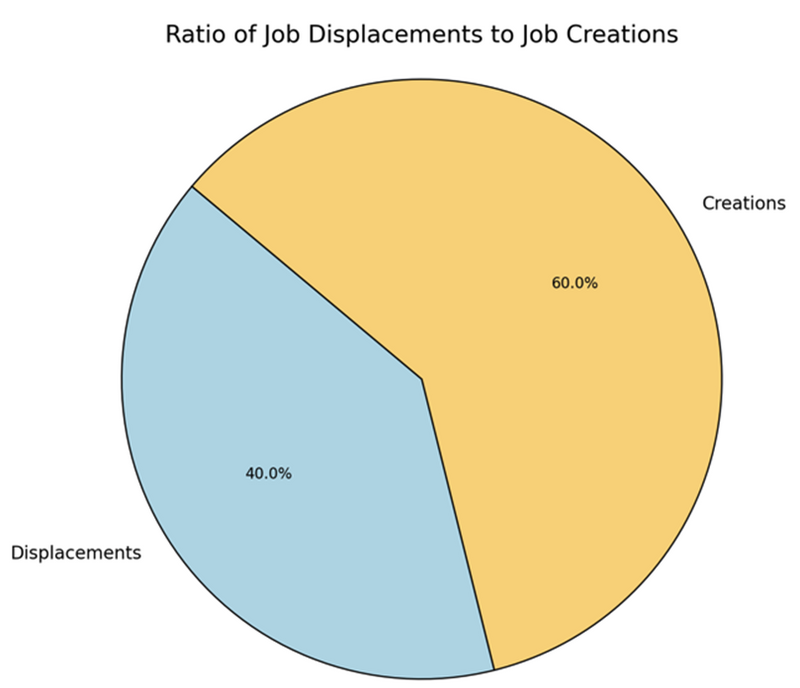
Source: Workforce Dynamics and New Roles (data sourced by Gartner)
These four pillars of AI resistance explain why certain professions remain human even as technology advances.:
Motion Recruitment’s 2025 analysis highlights a range of tech jobs that AI enhances rather than replaces. These roles remain in demand because they require strategic thinking, complex design, or stewardship of the very systems that power AI. The table below summarizes ten AI-proof tech careers and the human-centered skills that protect them.
| Tech Jobs | Why AI cant replace | Human-centred Skills |
| Software architects & senior developers | Designing scalable and secure systems requires architectural judgment, performance optimization, and complex decision-making that AI can’t match. | Systems thinking, optimization, cross-team communication |
| Cloud computing & DevOps professionals | AI can automate deployment and monitoring, but only humans can design cost-effective, resilient, and secure cloud architectures. | Infrastructure design, risk assessment, and incident response |
| Cybersecurity experts | AI helps with threat detection, but it cannot outthink novel cyber-attacks or handle complex breaches without human intuition and ethical hacking expertise. | Threat modeling, ethical hacking, and incident management |
| Product managers & UI/UX designers | AI can generate prototypes, but it lacks the creativity and empathy to shape a product vision and deliver delightful user experiences. | Vision setting, user research, design thinking |
| Robotics & embedded systems engineers | Integrating AI into hardware requires problem-solving across electronics, software, and mechanical systems—skills beyond AI’s reach. | Cross-disciplinary engineering, hardware–software integration |
| IT support & systems administrators | Chatbots handle simple queries, but diagnosing complex configurations and managing large-scale infrastructure requires human judgment. | Troubleshooting, network design, customer empathy |
| AI engineers | Far from being replaced, demand for engineers skilled in model optimisation and training is growing. | Machine learning expertise, algorithm tuning, and responsible AI |
| Data scientists & analysts | AI can process data, but humans define problems, interpret results, and convert insights into strategy. | Statistical reasoning, storytelling, and domain knowledge |
| Ethical AI & auditing professionals | Monitoring AI for bias and accountability is an emerging field that requires ethical judgment and regulatory knowledge. | Ethics, governance, compliance, andauditing |
| Emerging tech specialists | Specialists in biotech, blockchain, or quantum computing work at the frontier of knowledge where human expertise is irreplaceable. | Research, experimentation, interdisciplinary collaboration |
Before choosing a future-proof career path, it helps to understand which roles are most vulnerable to automation and which ones are likely to remain stable. Our guide on AI jobs at risk vs safe jobs breaks this down in detail.
Each of the roles above combines technical depth with human judgment. AI tools can accelerate coding or automate infrastructure tasks, but only people can design robust architectures, protect systems from evolving threats, or balance user needs with business goals.
These jobs also align with the World Economic Forum’s finding that technology skills, such as AI and cybersecurity, will see rapid growth in demand alongside human skills, such as creative thinking and resilience. APIDOTS’ own service stack reflects exactly this convergence: their DevOps services and Cloud Services are designed to support skilled professionals in building more resilient, future-ready infrastructure — not to replace the humans running it.
According to my research, jobs centered on empathy, physical skill, or cultural vision are especially AI-resistant. The list below summarises ten careers and why they persist. Although many are outside technology, they illustrate the same principles that make AI-proof tech roles secure.
Looking to build AI systems that empower teams rather than replace them? API DOTS offers end-to-end AI/ML development services, from intelligent automation and predictive analytics to custom machine learning solutions, designed to enhance human capability, not replace it. Discover how API DOTS develops scalable, secure AI-powered platforms.
Technology keeps evolving, so staying resilient means cultivating competencies that AI cannot easily replicate. According to PrometAI and reinforced by the World Economic Forum, seven human-exclusive competencies will rise in value:
Want to add technical fluency to your human skill set? APIDOTS offers IT consulting services to help professionals and businesses align their technology strategy with long-term goals, making it easier to upskill, adapt, and stay relevant in an AI-driven world.
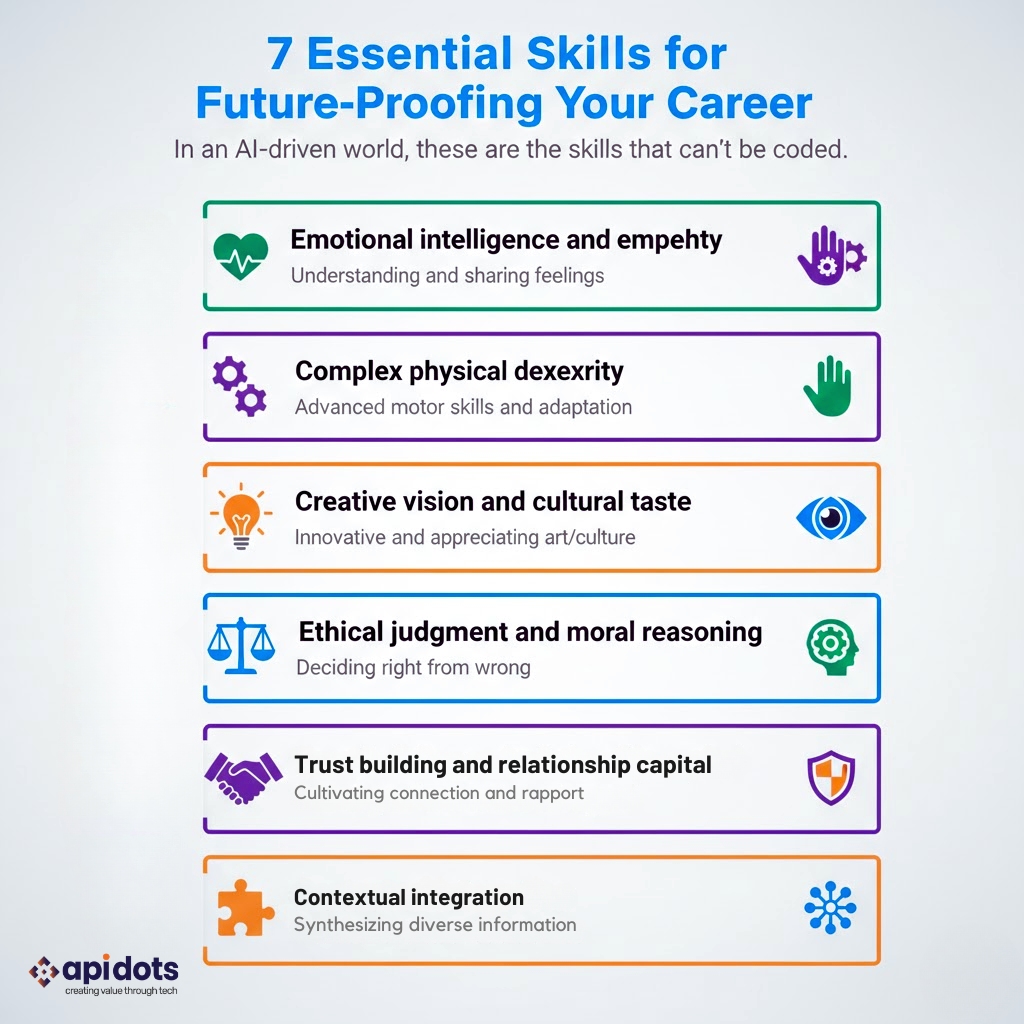
AI is a tool that amplifies what humans do best. Evidence from the World Economic Forum suggests that although AI will disrupt many roles, it will also create millions of new opportunities and elevate the importance of human-centric skills.
Tech jobs that design, secure, and govern AI systems are particularly safe, as are careers built on empathy, creativity, and physical skill. By investing in both digital fluency and uniquely human abilities, you can shape a future-proof career in the AI era.
As a trusted custom web and app development company, join API DOTS today and move beyond AI hype. Our team builds reliable, scalable AI systems that automate workflows and drive real results, from custom web and mobile development to SaaS platforms, cloud solutions, and AI/ML development. AI needs experts behind it. That’s where we come in.
No. AI is designed to handle specific tasks rather than replace entire roles. Careers that involve decision-making, creativity, and leadership will continue to be in demand.
Roles such as software architects, cybersecurity specialists, AI engineers, product managers, and cloud experts are considered more resilient to AI disruption.
Professions like healthcare, teaching, skilled trades, therapy, and emergency response rely heavily on human interaction and are less likely to be replaced.
Focus on building technical awareness along with human-centric skills like critical thinking, empathy, and ethical decision-making.
Yes. According to projections by the World Economic Forum, AI and related technologies are likely to result in a net increase in jobs by 2030.
We build and deploy end-to-end AI software solutions for businesses. Accelerating efficiency, automation, and intelligent decision-making.
Get AI Development Services
Hi! I’m Aminah Rafaqat, a technical writer, content designer, and editor with an academic background in English Language and Literature. Thanks for taking a moment to get to know me. My work focuses on making complex information clear and accessible for B2B audiences. I’ve written extensively across several industries, including AI, SaaS, e-commerce, digital marketing, fintech, and health & fitness , with AI as the area I explore most deeply. With a foundation in linguistic precision and analytical reading, I bring a blend of technical understanding and strong language skills to every project. Over the years, I’ve collaborated with organizations across different regions, including teams here in the UAE, to create documentation that’s structured, accurate, and genuinely useful. I specialize in technical writing, content design, editing, and producing clear communication across digital and print platforms. At the core of my approach is a simple belief: when information is easy to understand, everything else becomes easier. Reach me at amysbrew.com