
Top
Search
People also search for:

Stay Inspired with Instagram




Summary
Artificial intelligence is changing the way mobile apps connect with users and help businesses grow. This blog explains the top five business benefits of adding AI to mobile apps. It covers practical AI ideas for different industries and is useful for teams planning to build smarter, AI-powered mobile products.
Integrating artificial intelligence (AI) into mobile applications is no longer a futuristic concept. It is becoming a competitive necessity. The global mobile AI market was worth US $31.67 billion in 2025 and is forecast to reach US $274.88 billion by 2034, with North America accounting for more than one-third of the revenue. Delaying AI integration could result in significant lost opportunities.
Companies that delay implementing AI could experience a 10-15% decline in potential revenue growth each quarter. They also miss out on better customer experiences and improved efficiency. Early adopters of AI may gain more market share, making it harder for others to keep up.
The number of voice-enabled assistants grew from 4.2 billion devices in 2020 to 8.4 billion in 2024, and about 20.5% of people worldwide now use voice search. For busy executives, voice AI makes it easy to manage emails, schedule meetings, and get important updates without slowing down.
Product managers can make apps easier to use by adding voice features. Developers who want to boost engagement should build simple, intuitive voice interfaces. As companies strive to personalize experiences and enhance operations, understanding how to leverage AI in mobile apps is crucial.
APIDOTS has been helping businesses design and build AI-powered mobile apps by seamlessly integrating intelligent features like personalization, automation, and predictive analytics into scalable, production-ready products.
This blog will help you explore AI in mobile apps, evaluate ways of integrating AI, and spark AI app ideas for your business.
Artificial intelligence is like an app’s intuition, allowing it to sense, reason, learn, and make decisions just like a human would. In mobile apps, AI acts as a helpful assistant, often implemented as machine learning models.
These models are like the app’s brain, analyzing user data to make predictions or suggestions. For instance, natural language processing is the part of AI that helps chatbots and voice assistants understand and respond to human language. Similarly, computer vision is the app’s eyes, recognizing images, while generative models are like creative artists, generating new content.
Two architectures dominate:
AI models learn from historical data through a process called training, where algorithms adjust thousands of parameters in an effort to reduce prediction errors. The trained model will then make predictions for new data by predicting the response of the user, interpreting spoken commands, or indicating what the model thinks the next action will be.
For example, a happy user who was excited about their shopping cart may open their shopping application and see a personalized recommendation for a must-have item they had just thought about (excitement!). Upon receiving this seemingly intuitive recommendation, the user was so excited that they quickly made a purchase, demonstrating the application’s ability to anticipate and satisfy its users’ needs. Mobile apps either maintain the trained model or make calls to a remote inference API.
For instance, a shopping application may use the purchase history and web browsing history of users to determine what they may want to purchase next and offer them recommendations based on that information. Also, AI models may combine current information (for example, GPS location, sensor data, or data from applications like Google Maps) in real time with past information to send personalized offers and alerts to users.
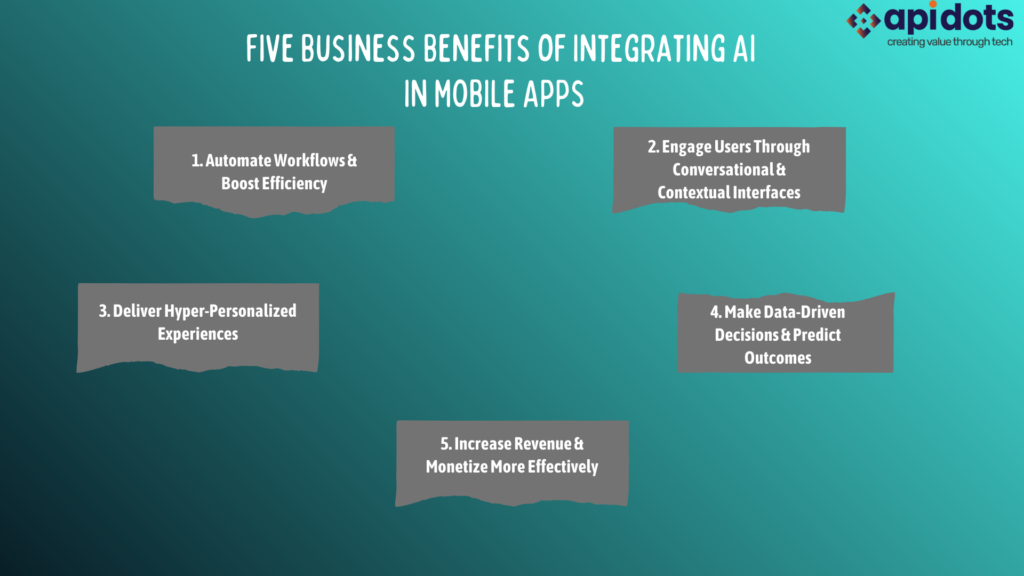
AI automates repetitive tasks, freeing employees and users to focus on higher-value work. In software development, AI-assisted coding and automated testing cut quality-assurance time by up to 40% and accelerate app launches by 40-60%.
For instance, before implementing AI, J.P. Morgan faced high rates of manual payment validation, with rejection rates causing bottlenecks and customer dissatisfaction. After integrating AI into their processes, they observed a 20% decrease in payment validation rejection rates, significantly enhancing the customer experience. Chatbots and virtual assistants provide 24/7 support, answer routine questions, and schedule appointments without human intervention.
Imagine starting your day with a voice command that sets the tone for everything you need to accomplish. Whether it’s setting reminders, playing your favorite music, or ordering your morning coffee, voice and chat interfaces transform how users interact with apps.
With 8.4 billion voice assistants in use and 20.5% of people using voice search, voice-enabled features like smart speakers, car assistants, and mobile voice search are becoming ubiquitous. Siri alone has over 86 million users in the U.S., revealing the significant market potential.
In education, AI powers interactive learning platforms like Kahoot! and Minecraft Education, gamifying the learning experience. In healthcare and wellness, AI-driven fitness apps monitor biometrics to deliver adaptive workout plans.
More than 50% of consumers say they would use AI for personal training. Positioning AI as a sidekick for daily challenges elevates its role as a seamless, engaging, and indispensable part of modern life.
Personalization is a powerful revenue driver. Research shows that companies excelling at personalization generate 40 % more revenue than those that don’t, and personalization drives a 10–15 % revenue lift, with top performers seeing up to 25 %.
In mobile banking, AI tailors financial products and advice to each customer, increasing engagement and loyalty. Adaptive learning platforms like DreamBox and Smart Sparrow adjust lessons based on student performance, resulting in more effective learning experiences.
AI transforms raw data into actionable insights. Predictive analytics can forecast demand, identify churn risks, or detect fraud. In education, platforms like Knewton Alta use learning analytics to provide instructors with actionable dashboards and suggest content based on student needs. AI helps banks spot anomalous transactions early, strengthening fraud detection and reducing financial losses.
However, it is crucial to acknowledge that predictive models can decay over time due to model drift, which occurs as new data diverges from the data on which the model was trained. To maintain accuracy and reliability, establishing a regular retraining cadence is essential. By being transparent about the need for ongoing maintenance, companies can build trust with users and leverage AI effectively.
Gartner predicts that 40% of enterprise applications will integrate task-specific AI agents by 2026 (up from less than 5% in 2025), and these agents could generate around 30% of enterprise software revenue by 2035. Implementing AI now will give companies a head start in this data-driven future.
AI not only boosts efficiency but also drives revenue. Apps using AI to personalize content and offers see 20–30 % improvements in retention and customer lifetime value. Monetization features like dynamic pricing, targeted advertising, and personalized subscription bundles can yield 15–25 % higher revenue growth compared with traditional methods.
Furthermore, research predicts that more than 70 % of enterprise mobile apps will use AI-driven features by 2026. Adopting AI now positions your app to capture these growth opportunities as the market matures.
Implementing AI requires thoughtful planning. The following steps, adapted from modern development practices, can guide a smooth integration:
AI technologies create opportunities across industries. Here are some sectors where integrating AI into mobile apps pays off:
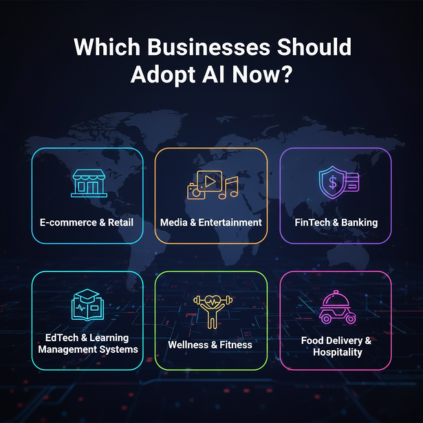
Retailers use AI to offer personalized recommendations, dynamic pricing, and targeted promotions. Product suggestions can account for up to 31 % of online revenue and boost sales by 20 %. Chatbots guide buyers, answer questions, and reduce cart abandonment. Real-time demand forecasting helps optimize inventory and logistics.
Streaming services employ AI to curate content and predict what viewers will enjoy. Personalized playlists, auto-generated summaries, and voice-controlled interfaces increase user engagement. Adaptive advertising uses viewer behavior to deliver relevant ads, improving conversion rates.
AI automates routine banking tasks (e.g., data entry and reporting) and enhances fraud detection. By analyzing customer data, banks can tailor financial products and credit decisions, enhancing customer satisfaction and cross-selling. Generative AI tools also assist employees by surfacing internal knowledge and accelerating onboarding processes.
Adaptive learning platforms like DreamBox, Smart Sparrow, and Knewton Alta personalize lessons and assessments for each student. These platforms have been shown to significantly enhance learning outcomes; for example, students using such technologies have seen as much as a one-grade level improvement within a six-week period.
AI tools automate grading (e.g., Gradescope), generate feedback, and offer accessibility features like speech-to-text transcription. AI proctoring and plagiarism detection uphold assessment integrity while scaling to large cohorts.
The AI fitness market was valued at US $9.8 billion in 2024 and is projected to exceed US $46 billion by 2034. Consumers increasingly seek personalized workout plans; more than 50 % of people would use AI-powered personal training. Apps can adjust workouts in real time based on biometrics and integrate with wearables to provide holistic health insights.
AI can optimize delivery routes, forecast demand, suggest dishes based on past orders, and manage inventory. Personalized promotions encourage repeat orders, and chatbots can handle reservations and food allergies. AI also assists with dynamic pricing and upselling.
AI adoption in mobile apps is accelerating. Analysts expect more than 70 percent of enterprise mobile apps to include AI features by 2026, and Gartner predicts that task-specific AI agents will power 40 percent of enterprise applications by the same year. With such rapid growth, integrating AI now is essential to stay competitive, delight users, and unlock new revenue streams.
By automating workflows, enabling conversational interfaces, delivering hyper-personalization, providing predictive insights, and driving revenue, AI transforms mobile apps into intelligent companions.
Whether you operate in e-commerce, education, finance, wellness, or hospitality, consider how AI app ideas can elevate your business today and position you for success tomorrow. Integrate early, iterate often. Talk to us today at APIDOTS. We help startups and enterprises integrate AI into mobile applications—from strategy and architecture to development and deployment.
We design and develop secure, high-performance web and mobile applications.Ensuring scalability, reliability, and long-term product success.
Hire App Developers
Hi! I’m Aminah Rafaqat, a technical writer, content designer, and editor with an academic background in English Language and Literature. Thanks for taking a moment to get to know me. My work focuses on making complex information clear and accessible for B2B audiences. I’ve written extensively across several industries, including AI, SaaS, e-commerce, digital marketing, fintech, and health & fitness , with AI as the area I explore most deeply. With a foundation in linguistic precision and analytical reading, I bring a blend of technical understanding and strong language skills to every project. Over the years, I’ve collaborated with organizations across different regions, including teams here in the UAE, to create documentation that’s structured, accurate, and genuinely useful. I specialize in technical writing, content design, editing, and producing clear communication across digital and print platforms. At the core of my approach is a simple belief: when information is easy to understand, everything else becomes easier. Reach me at amysbrew.com