
Top
Search
People also search for:

Stay Inspired with Instagram




Summary:
Automation in 2026 is no longer about choosing between RPA and Intelligent Automation, but about how effectively they work together. This blog explains the strengths and limitations of both approaches and outlines when to apply each. It highlights the growing need for orchestration, integration, and scalability as automation ecosystems expand. Ultimately, it provides a practical framework for building a future-ready automation strategy aligned with real business outcomes.
Automation has evolved from a back-office convenience into a strategic enabler. Robotic process automation (RPA) began as a way to script repetitive, rule-based tasks, clicking through screens, filling forms, and copying data without modifying underlying systems.
Now, intelligent automation (IA) adds machine learning (ML), natural language processing (NLP), and decision engines to handle complex workflows involving unstructured data and dynamic decision-making. As organisations plan for 2026, the question is no longer whether to automate but how to align the right technology with the right processes.
The guide aims to help you understand the basic differences between RPA and intelligent automation. It also provides valuable insights regarding market trends, use cases, and the procedure of selecting the best automation strategy.
RPA Technology is software that uses ‘bots’ to perform repetitive tasks on a computer. These bots can move around user interfaces, collect information, and issue commands exactly as they were programmed. For example, an RPA technology primer states that RPA is part of the essential kit for automating clerical and other routine duties.
Bot development is skill-intensive as the commands and codes are top-secret. Also, RPA is logic-based and requires consistent rules for every process and the data used. The key benefits of RPA include accurate, efficient legacy systems, minimal setup time, and a very attractive ROI.
Intelligent automation, also known as IPA, is a term combining RPA with artificial intelligence applications like ML, NLP, and computer vision. IPA is a combination of RPA and AI technologies that can handle complex processes, such as decision-making and learning.
The IA systems process initial documents as well as information that comes from different sources and apply rule-specific characteristics. This enables the systems to respond to the language being used, interpret the language, uncover anomalies, and enhance the application’s performance. Why does IA sometimes prove to be more advantageous than RPA or AI? The answer lies in the fact that IA is not isolated from performing tasks; it is oriented to making the whole process automated.
1. Rule-based vs. learning-based: RPA bots follow predefined rules and do not adapt; if a workflow changes, human intervention is required. Intelligent automation uses AI to detect patterns and make decisions, enabling it to handle exceptions and learn from experience.
2. Data handling: RPA requires structured data (forms, spreadsheets, relational databases) and cannot process unstructured content. IA can ingest and interpret unstructured data such as emails, documents, and voice messages.
3. Human supervision: RPA often needs human oversight for exceptions, system changes or data format variations. IA reduces human involvement by learning from data and escalating only high-risk cases.
4. Implementation complexity: RPA implementations focus on defining clear rules and configuring bots. IA requires data collection, model training, and continuous tuning.
5. Decision-making: RPA can only execute preprogrammed actions; IA can analyse data, detect trends, and make decisions.
RPA excels in situations that require speed, consistency, and compliance. Key advantages include:
Use RPA when processes are highly repetitive, rules are stable, inputs are structured, and quick wins are desired. Examples include data entry, report generation, invoice processing, and system migrations.
Smart automation works best in complex, data-intensive environments. Some of the advantages include the following:
Designating IA to the type of tasks that involve making a decision, involve variable data, or are about end-to-end automation, such as customer support, along with sentiment analysis, fraud detection, supply chain planning, and personalized marketing.
The automation landscape is growing rapidly, driven by remote work, digital transformation, and AI advancements. Several statistics highlight this momentum:
☐The global robotic process automation (RPA) market was valued at USD 3.79 billion in 2024 and is projected to grow rapidly to USD 30.85 billion by 2030, reflecting a strong CAGR of 43.9% driven by businesses seeking greater operational efficiency and cost reduction.
☐North America led the market with over 39% share in 2024, with the U.S. showing significant growth momentum. Cloud-based deployments dominated adoption with more than 53% share, while services accounted for 64% of revenue, and large enterprises remained the primary adopters.
☐Across industries, organizations are using RPA to automate repetitive, rule-based tasks, reduce human error, and shift resources toward higher-value work, with cost savings being a major benefit—evidenced by a 2024 survey showing that over half of financial services firms saved at least USD 100,000 annually through automation
☐The intelligent process automation market is projected to reach $33.4 billion by 2029, growing at a CAGR of 16.8%, driven by AI-powered automation, cloud-based deployments, industry-specific solutions, enhanced customer experience, and increased support for remote workforces.
☐The growth forecast reflects a 0.7% downward revision from earlier estimates, largely due to the impact of global trade tariffs increasing costs for robotic and AI components, which may slow automation adoption and affect broader economic activity.
These trends illustrate how automation is shifting from isolated pilots to enterprise-wide strategies by 2026. Organisations that pair RPA with AI technologies will be better equipped to handle growing data volumes and complex workflows.
Modern automation spans many functions. Below are representative scenarios highlighting how RPA and IA complement each other:
| Function/Industry | RPA Use Cases | Intelligent Automation (IA) Extensions |
| Finance & Accounting | Extract data from invoices, enter it into ERP systems, and apply rules to validate amounts | Use AI to extract data from unstructured invoices, detect anomalies, and flag fraud |
| Customer Support | Generate support tickets from web forms, route to appropriate teams, and update statuses | Apply NLP to analyse emails or chat logs, prioritise tickets based on sentiment, and provide automated responses |
| Loan Application Processing | Collect structured applicant data, perform initial screening and upload documents | Analyse unstructured documents like bank statements, assess risk using ML models and recommend approvals |
| Employee Onboarding | Fill forms, create accounts, and send notifications | Verify documents using AI and personalise onboarding experiences |
| Healthcare | Update patient records and manage billing | Use AI to interpret medical images, detect billing anomalies and suggest diagnoses |
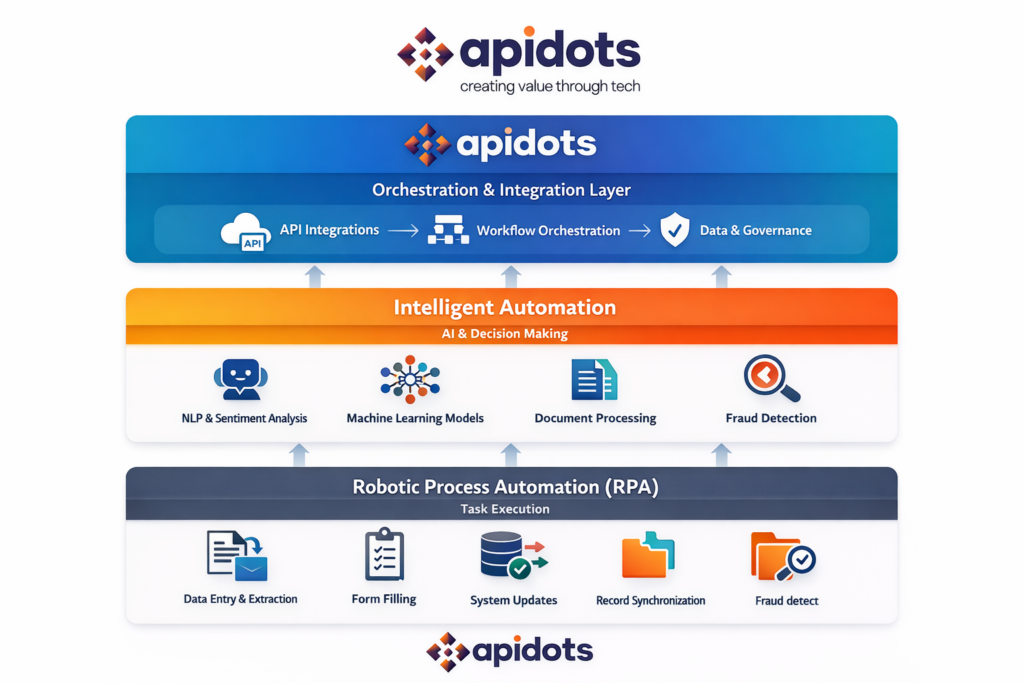
These examples demonstrate that many processes start with RPA but gain greater impact when augmented with intelligence. With the rapid rise of hyper-automation (combining RPA, AI, process mining, and analytics), organisations in 2026 will orchestrate entire digital workflows, not just tasks.
Selecting between RPA and intelligent automation depends on multiple factors:
A pragmatic roadmap is to implement RPA for quick wins and process stabilization, then layer intelligent automation to tackle complex tasks and decisions.
As automation initiatives mature, organizations often struggle with fragmented systems, disconnected workflows, and brittle integrations. This is where platforms like APIDOTS become valuable, serving as an integration and orchestration layer that connects automation tools, APIs, and data flows into a unified operational framework.
By 2026, automation will be less about isolated bots and more about orchestration. Processes cross departments and platforms, requiring seamless integration and governance.
By subtly weaving integration capabilities into your automation plan, APIDOTS can help with orchestrations, API connectors, and monitoring, appealing to business leaders seeking a unified solution without overtly pitching the product.
The debate between RPA and intelligent automation continues. Organizations that thrive in 2026 will deploy both technologies in a layered fashion. RPA provides speed, accuracy, and quick wins; intelligent automation brings adaptability, intelligence, and long-term scalability.
Market momentum indicates that RPA adoption is widespread and growing, with the global market projected to exceed US$30 billion by 2030, and 76% of organizations already integrating RPA. Intelligent automation adoption is accelerating, with around 80% of companies projected to adopt IA by 2025 and delivering significant efficiency gains across finance, retail, healthcare, and manufacturing.
For businesses planning their 2026 automation strategy, the question is not RPA vs IA but how to sequence and integrate them. Start by automating well-defined tasks with RPA. Then, leverage intelligent automation to handle complexity, learn from data, and support decision-making.
Use integration platforms like APIDOTS to orchestrate workflows, unify data, and ensure governance. This balanced approach will unlock efficiency, innovation, and sustained competitive advantage in the era of agentic AI.
We engineer robust, future-ready software solutions.Built using modern architectures and proven development practices.
Hire Developers
Hi! I’m Aminah Rafaqat, a technical writer, content designer, and editor with an academic background in English Language and Literature. Thanks for taking a moment to get to know me. My work focuses on making complex information clear and accessible for B2B audiences. I’ve written extensively across several industries, including AI, SaaS, e-commerce, digital marketing, fintech, and health & fitness , with AI as the area I explore most deeply. With a foundation in linguistic precision and analytical reading, I bring a blend of technical understanding and strong language skills to every project. Over the years, I’ve collaborated with organizations across different regions, including teams here in the UAE, to create documentation that’s structured, accurate, and genuinely useful. I specialize in technical writing, content design, editing, and producing clear communication across digital and print platforms. At the core of my approach is a simple belief: when information is easy to understand, everything else becomes easier. Reach me at amysbrew.com