
Top
Search
People also search for:
Stay Inspired with Instagram




Key Takeaways
Small businesses (10–100 employees) operate in a world of big challenges with lean resources. Many owners and staff wear the “IT hat” by default, juggling network support, cybersecurity, and cloud decisions alongside day-to-day work. An IT services provider for small businesses delivers managed technology, security, and cloud support to help teams operate efficiently and grow reliably.
An estimated 44 % of small businesses host their workloads and data in the cloud, yet many still do not leverage cloud services, even though technology drives everything from sales to customer service. With broader small-business staffing challenges, such as 43 % reporting difficulty filling job openings, the lack of dedicated IT support can increase downtime, security incidents, and missed opportunities that derail growth.
This guide illustrates how services such as managed IT, cloud migration, DevOps, AI/ML and mobile application development give small firms enterprise-level capabilities while controlling costs.
Small businesses seldom have enough in-house specialists to manage today’s complex tech stack. A single “IT person” (if any) may be responsible for networking, security, software updates and troubleshooting, leaving little time for strategic projects. Business Owners and Non-Technical Staff Causing Reduced Productivity and Increased Risk
When business owners or non-technical employees fill in the gaps where there is a lack of technical expertise, both productivity decreases and risks increase due to:
A knowledgeable IT Service Provider can alleviate these challenges by providing proactive technology management, tactics for long-term success, and access to specialized skillsets. Most IT services will be offered through either a contract on a monthly or annual basis, based on the needs of the client.
Adoption of managed IT services among small businesses has skyrocketed. Recent surveys show that over 60 % of SMBs already use managed services, and almost 90 % either use an MSP or are considering one. When asked why, most emphasize cost savings, improved security and confidence in their systems. Indeed, 93 % of organizations using managed services report improved operational efficiency.
Managed IT agreements typically include some or all of the following:
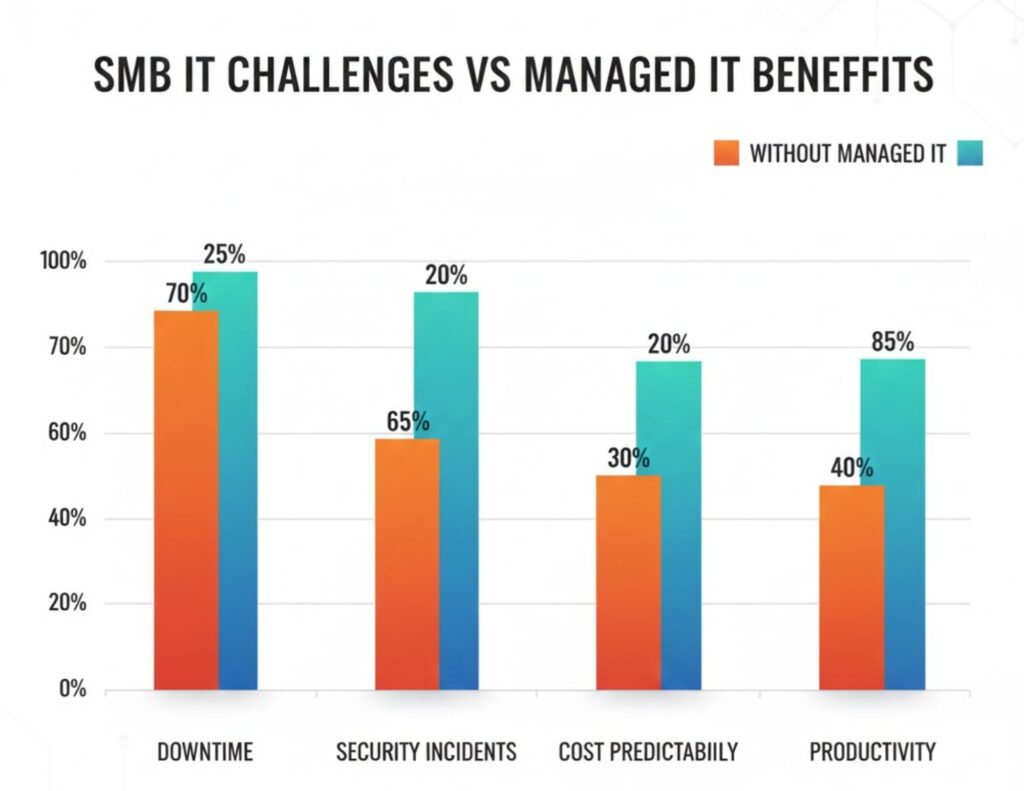
The comparison clearly shows how managed IT services reduce downtime and security risks while improving cost predictability and productivity for small businesses.
Managed IT has a compelling economic case for small businesses. such as it helps in:
1. Eliminating reactive expenses
2. Avoiding large capital expenditures
3. By using economies of scale to their advantage, an MSP can invest in the latest cutting-edge technology (monitoring, threat intelligence, backups) and then distribute the costs across all their clients, allowing small businesses to get enterprise-level solutions at a cost-effective price.
4. A breach or ransomware attack may cost small business owners tens of thousands of dollars (or more). Stronger protection and backup systems can help reduce the risk of this happening.
5. The ability to quickly resolve technology issues allows employees to stay focused on their business role.
Many small businesses start with managed IT and gradually move toward cloud and AI initiatives as they grow. With the right technology partner like APIDOTS, you can focus on the solutions that matter most at your current stage and scale confidently for the future.
Moving from on-premises servers and software to cloud-based services offers major benefits: agility, scalability, cost savings and remote collaboration. For small businesses, the cloud has become essential. Budgets reflect this shift; research indicates that more than half of SMB tech spending went to cloud solutions in 2025.
While attractive, moving to the cloud requires careful planning. A poorly executed migration could create outages, high costs, and exposure of your data to security vulnerabilities. IT Providers have the expertise to help make sure that your migrations go smoothly by:
Technology continues to evolve beyond cloud and cybersecurity. Forward-thinking small businesses can harness emerging tools to automate tasks, engage customers and create new revenue streams. Here are three areas where an IT partner such as APIDOTS can help you innovate:
1) Artificial Intelligence (AI) and Machine Learning (ML)
Businesses of any size can be successful in using Artificial Intelligence (AI) and Machine Learning (ML). According to the results from many early adopters, 85% of respondents say that they are enjoying increased productivity from their AI initiatives. There are a variety of ways for small and medium sized businesses (SMBs) to start taking advantage of the practical uses of AI, including:
• Using chatbots or virtual assistants to assist customers with frequently asked questions, set up appointments or direct support issues.
• Utilizing predictive analytics to predict sales, inventory requirements, and scheduling of maintenance.
• Automating document processing to extract the information from invoices, receipts or other documents.
• Employing algorithms to deliver tailored messages or offers based on a customer’s behavior.
With the right IT partner, SMBs can identify high impact projects where AI can be applied within their company, find low-cost solutions (often available in the cloud or as SaaS) and integrate them into their workflow. The IT partner will also ensure that quality data is being used for the models that will be developed and help establish feedback loops that continuously refine the models.
2) Why DevOps Is Essential for Efficient Software Development
If a company develops any type of software for either an internal purpose (such as an internal tool) or externally (a Web portal or a Mobile App) then it will need to develop a way to increase its efficiency in building, testing, and releasing software updates. The practice known as DevOps allows companies to bring together development and operations so that these processes can be streamlined. The benefit of using DevOps include:
These practices are now accessible to small teams through cloud services and open-source tools. By adopting DevOps, SMBs can iterate quickly and compete with larger software providers. read more….
3. Custom mobile and web applications
Many small businesses now extend their brand or services through custom apps—such as loyalty programs, online ordering, appointment scheduling, or subscription content. In other cases, they build internal web portals or SaaS platforms to manage operations or deliver industry-specific functionality.
Developing such applications requires a mix of design, backend development, API integration and deployment expertise.
APIDOTS is an example of a comprehensive IT services provider committed to small and mid-sized businesses. With experience across managed IT, cybersecurity, cloud migration, DevOps, AI/ML, mobile applications and SaaS development, APIDOTS offers a single partner for all your technology needs. We pride ourselves on:
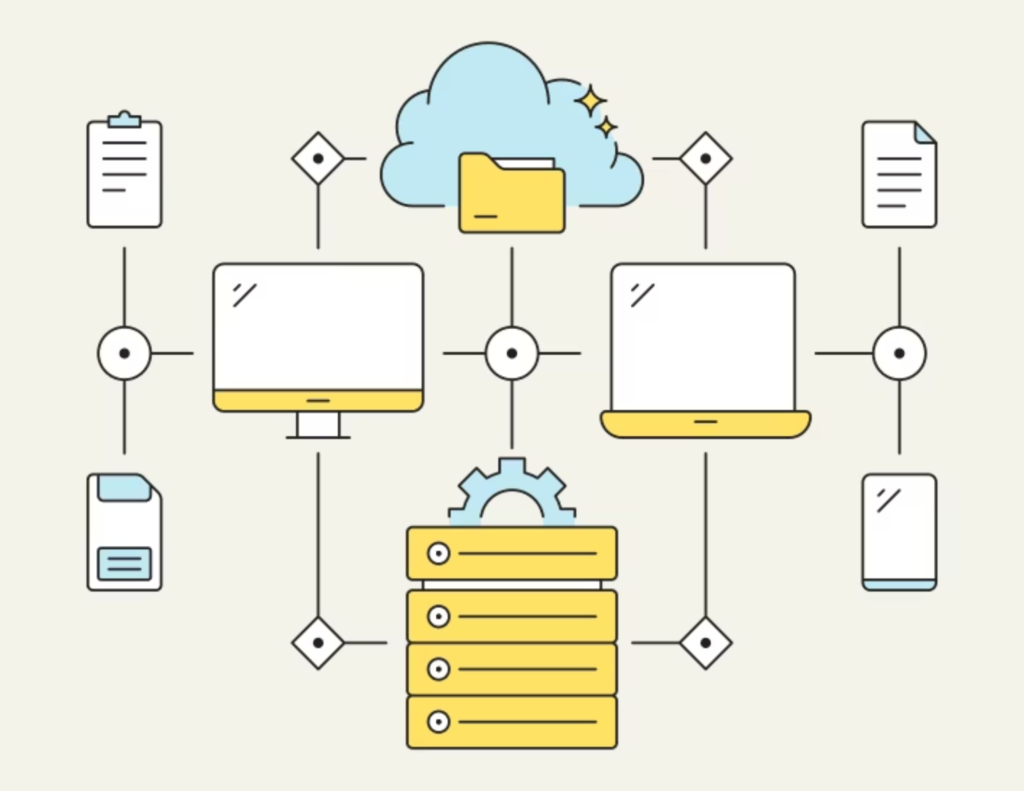
When partnering with APIDOTS, your focus can remain on the core mission of your business: providing excellent customer service, creating innovative products, and growing into new markets. While we supply the technological foundation that supports and powers your business activities, other partners’ services also include training in product development.
Small businesses are often challenged with dealing with the technology required for their operations. Many small businesses do not have the financial resources to hire a full-time specialized IT employee. In addition to hiring specialists, there is a constant change in technology along with the ever-increasing threat of cybercrime, making every aspect of technology feel like a potential liability.
Many small businesses are now using managed IT services like cloud services to migrate their business to the cloud and utilize emerging technologies, including artificial intelligence (AI) and DevOps, as a way to create a competitive edge in their marketplace. The smaller scale does not guarantee lower-quality mechanical (IT) and other services.
The current state of the digital economy is that technology plays a pivotal role in every business’s success. Rather than using the technology to hinder your company’s growth, utilize your technology as a vehicle for your company’s growth.
Whether you are operating a boutique design firm, are a growing legal firm or are the local manufacturer, your path to success lies not in trying to run away from utilizing technology as a way of achieving success. Partner with experienced professionals, such as APIDOTS, who specialize in working with small business owners, and allow these professionals to help you and your company flourish in your marketplace.
1. What does an IT services provider do for small businesses?
They manage networks, cybersecurity, cloud systems, software updates, and provide strategic IT consulting.
2. Is managed IT affordable for small businesses?
Yes. Managed services offer predictable monthly pricing, reducing unexpected repair and downtime costs.
3. How do IT providers improve cybersecurity?
Through firewalls, monitoring, employee training, backups, and compliance management.
4. When should a small business move to the cloud?
When scalability, remote access, and cost control become priorities.
5. Can small businesses benefit from AI and DevOps?
Absolutely. AI improves efficiency while DevOps speeds up software releases.
We manage and optimize your IT infrastructure end-to-end.Ensuring stability, security, and operational continuity.
Consult IT Experts
Hi! I’m Aminah Rafaqat, a technical writer, content designer, and editor with an academic background in English Language and Literature. Thanks for taking a moment to get to know me. My work focuses on making complex information clear and accessible for B2B audiences. I’ve written extensively across several industries, including AI, SaaS, e-commerce, digital marketing, fintech, and health & fitness , with AI as the area I explore most deeply. With a foundation in linguistic precision and analytical reading, I bring a blend of technical understanding and strong language skills to every project. Over the years, I’ve collaborated with organizations across different regions, including teams here in the UAE, to create documentation that’s structured, accurate, and genuinely useful. I specialize in technical writing, content design, editing, and producing clear communication across digital and print platforms. At the core of my approach is a simple belief: when information is easy to understand, everything else becomes easier. Reach me at amysbrew.com