
Top
Search
People also search for:
Stay Inspired with Instagram





Summary
Many business owners type “software development company near me” or search for the best website design companies for small businesses, hoping that proximity will solve their problem. In reality, the right partner can be anywhere. The key is finding a team that understands your goals, communicates well and delivers quality.
This guide explains why location is less important than talent, how remote/offshore development can benefit you, and what to look for in a partner. It also provides practical vetting tips and ends with a clear call-to-action for companies that want help navigating the process.
When hiring a software development company, it’s tempting to choose someone in your city. This can feel safe – shared time zones, face-to-face meetings and the ability to drop in on their office. But the digital world makes geography less relevant. Onshore, nearshore and offshore teams all have pros and cons.
For example, offshore development is often chosen for cost-effectiveness because labour and operational costs are lower in countries outside North America and Western Europe. Nearshore teams in neighbouring countries offer a balance of cost savings and time-zone alignment, while onshore teams make real-time collaboration easier.
Many business owners type “software development company near me” or search for the best website design companies for small businesses, hoping that proximity will solve their problem. In reality, the right partner can be anywhere. The key is finding a team that understands your goals, communicates well and delivers quality.
Choosing a company based solely on its address might exclude talented partners. Rather than focusing on time zones, consider:
When companies establish expectations through clear communication and utilize appropriate communication technologies, they can build similar working relationships with remote teams that can perform at a level equal to, or in some cases better than, a local partner.
The BPO market is undergoing tremendous growth, with projected compound annual growth rates between 2023 and 2027 to reach an estimated market size of $483 billion at a CAGR of 8.5%. BPO has gained in popularity as businesses become more dependent on BPO to manage important functions. Businesses utilize BPO for key functions, including HR, accounting and customer service.
This growth has been fueled by the now-abundant supply of available skilled professional resources worldwide, as well as an unending demand for those services. The size of the BPO marketplace is expected to increase from $245 billion in 2019 to nearly twice that amount—$492 billion by 2028.
Business process outsourcing remains an attractive option for companies seeking to enhance and improve their operational efficiencies, as they rely on third-party suppliers to execute the increasingly complex nature of their operations.
The reverse is also true; thus, we have seen increasingly high levels of outsourcing in business, with increasing numbers of companies realizing the increased productivity and operational efficiency produced by outsourcing.
As we approach the end of 2025 and the beginning of 2026, we will witness continued transformation of the overall outsourcing market. The umbrella of technology will continue to dramatically alter the way businesses outsource and operate. Knowledge of the latest statistics and trends for Outsourcing and BPO is critical.
Working with a remote or offshore partner can offer significant advantages:
1. Cost savings. Using talent from countries with lower labour costs reduces overall development expenses while maintaining quality.
2. Access to global talent. Offshore development allows companies to tap into a diverse, highly skilled workforce. You are not limited by your local market’s talent pool.
3. Flexibility and scalability. Remote teams can scale up or down quickly based on project needs, and time-zone differences can enable round-the-clock progress.
4. Focus on your core business. Outsourcing development lets you concentrate on strategy, sales or operations while experts handle coding.
These benefits explain why remote software development is growing rapidly. Companies are recognising that the right partner can be across town or across the globe.
Whether you’re searching for a software development company near me or a firm across an ocean, the criteria for selection remain the same. Here’s what to prioritise:
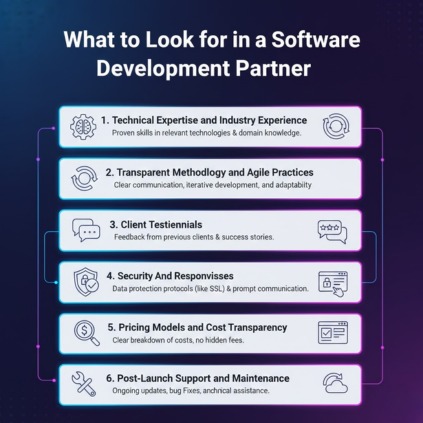
A reliable software development company should demonstrate technical expertise in the technologies you need, proven industry experience and transparent methodologies. Matching expertise with relevant industry experience is particularly important – for example, a fintech startup benefits from a company that has built similar financial applications.
Ask about the company’s development workflow. Do they use agile practices such as sprints, daily stand-ups and regular retrospectives? Transparent project management and frequent feedback loops improve visibility and allow for course corrections. Beware of firms that can’t explain their process or don’t have strategic project management – poor communication and inadequate planning often lead to delays.
Examine the portfolio of the company to ensure that they have carried out projects similar to yours. A varied portfolio demonstrates flexibility in the approach to different requirements in different companies. Remember that visual design is important, but you should also assess satisfaction based on functionality, experience for the user and overall performance.
The best way to determine the reliability and professionalism of a company is through client testimonials and its reputation in the industry. Reading client testimonials can show you if there are themes that consistently appear within the feedback received. Are the clients regularly stating that they met their deadlines? Did they have positive interactions with the company’s staff when communicating? Were they able to solve the problems that they encountered? If so, this is a strong indicator of a company that is going to be a dependable partner.
For web projects, features like SSL encryption and responsiveness aren’t optional – 53 % of mobile visitors leave a page that takes more than three seconds to load, and mobile devices account for over half of web traffic.
Costs vary based on complexity, team composition, location and engagement model. Hiring in the US or UK is typically more expensive than in Eastern Europe, where developers charge about $45 per hour versus $100 per hour in the US. Understand whether the company offers fixed-price, time-and-materials or dedicated team models. For startups, a time-and-materials model can be more flexible. Obtain a detailed proposal and compare it with your budget and timeline.
Software doesn’t end at launch. Discuss the level of support the company provides after deployment. Ongoing maintenance, security updates and feature enhancements are essential for keeping your product relevant and secure.
Small businesses often search for the best website design companies. The criteria above apply, but there are additional factors:
By applying these criteria, you’ll avoid common pitfalls like choosing the cheapest option or focusing solely on aesthetics.
Selecting a software development or website design partner is a significant decision that can shape your business’s future. While searching for a software development company near me or best website design companies for small business may feel comforting, but geography should not be the deciding factor.
There are many more important factors to consider, such as expertise, strong communication abilities, established processes, proven industry experience, and quality of support, than just being located within the same geographical area. You may be able to save money by selecting a remote or offshore group, and you may be able to connect with a variety of talented professionals through either of these options.
Choosing the right partner isn’t just about code or design – it’s about building a reliable foundation for your business. APIDOTS helps companies orchestrate development workflows and integrate software solutions through structured APIs, making it easier to manage remote teams, automate processes and scale without losing control.
If you’re ready to build your next product and want guidance on finding and working with the best development partners – regardless of location – explore how APIDOTS can support your journey.
We engineer robust, future-ready software solutions.Built using modern architectures and proven development practices.
Hire Developers
Hi! I’m Aminah Rafaqat, a technical writer, content designer, and editor with an academic background in English Language and Literature. Thanks for taking a moment to get to know me. My work focuses on making complex information clear and accessible for B2B audiences. I’ve written extensively across several industries, including AI, SaaS, e-commerce, digital marketing, fintech, and health & fitness , with AI as the area I explore most deeply. With a foundation in linguistic precision and analytical reading, I bring a blend of technical understanding and strong language skills to every project. Over the years, I’ve collaborated with organizations across different regions, including teams here in the UAE, to create documentation that’s structured, accurate, and genuinely useful. I specialize in technical writing, content design, editing, and producing clear communication across digital and print platforms. At the core of my approach is a simple belief: when information is easy to understand, everything else becomes easier. Reach me at amysbrew.com