
Top
Search
People also search for:
Stay Inspired with Instagram




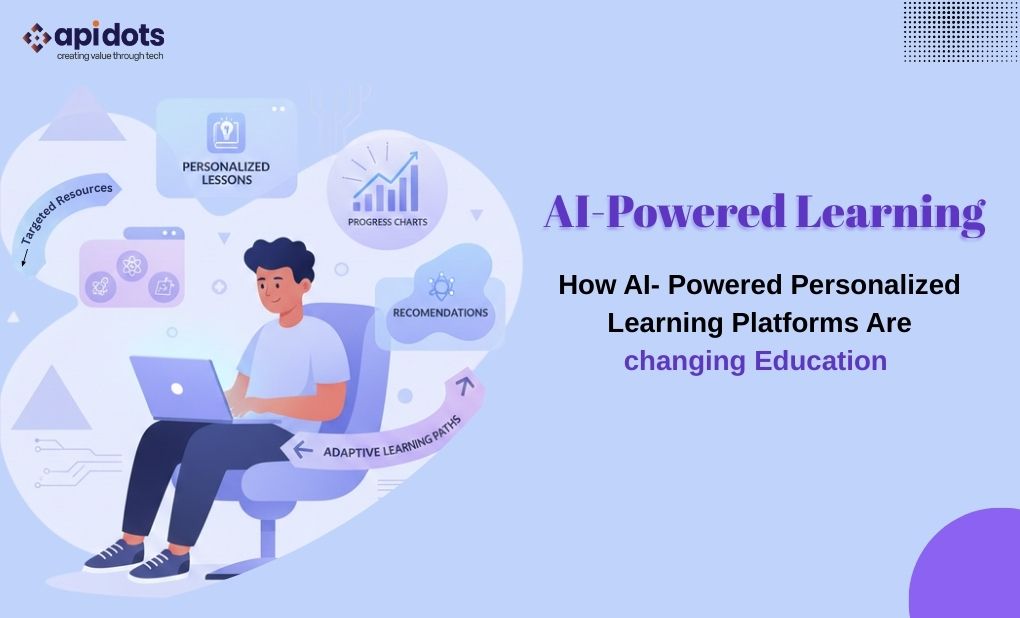
Education is undergoing a quiet revolution. Not the kind fueled by fancy buzzwords or flashy gadgets, but by something much deeper: the ability to understand each learner as an individual. For years, teachers have dreamed of giving every student a personalized roadmap. Today, AI Personalized Learning is turning that dream into an achievable, scalable reality. If you’re an educator, an EdTech startup founder, or an institution thinking of upgrading your digital infrastructure, this transformation isn’t a future trend — it’s already here. And the organizations embracing it today will become tomorrow’s leaders.As a team that has built high-performance EdTech platforms for institutions, coaching centers, universities, publishers, and training companies, we’ve seen this shift up close.
In this guide, I’ll explain how AI-powered personalized learning works, what makes it game-changing, and how you can build a system that actually delivers outcomes, not just hype.
The global AI in education market reached $7.05 billion in 2025 and is projected to grow to $112.30 billion by 2034—representing a robust 36.02% compound annual growth rate, according to Precedence Research. This exponential expansion is driven by widespread adoption of AI technology and increased government investment in education worldwide, signaling a fundamental transformation in how learning is delivered globally. In the U.S., 82% of school districts have implemented AI initiatives. Finland leads Europe with 91% of public schools using AI for personalized learning. India introduced AI tools to 68% of rural schools for math and science education by March 2025. The data is precise: 88% of students recognize AI’s importance in learning, while 75% of higher education leaders believe AI will play a critical role shaping institutional futures. However, only 20% of students agree that AI should replace human teachers—highlighting that AI augments rather than replaces educators.
AI Personalized Learning isn’t just putting content online or giving quizzes. It means:
Think of it as having a mentor who never gets tired, never loses patience, and never stops analysing how to improve your experience.
But AI isn’t replacing educators. Instead, it’s giving them superpowers.
Every school, EdTech startup, and training company faces mounting pressure to improve learner outcomes—faster, more affordably, and at scale. The AI in personalized learning and education technology market reached $6.5 billion in 2024 and is projected to surge to $208.2 billion by 2034, representing a remarkable 41.4% compound annual growth rate. This explosive growth reflects a fundamental shift in how education is delivered worldwide.
Traditional education follows a linear model: Chapter 1, Chapter 2, Chapter 3. But learners aren’t linear. They skip ahead, struggle with specific concepts, repeat content, and learn at vastly different paces. One-size-fits-all instruction creates inefficiencies that AI-powered systems are uniquely positioned to solve.
AI systems continuously map each learner’s proficiency level, engagement patterns, preferred content formats, quiz performance, and retention ability.
Research from 2024 shows that students in personalized learning programs scored 8 points higher in math and 9 points higher in reading than those in traditional instruction. The system automatically adjusts learning paths in real time—something that is impossible to achieve manually at scale.
Student dropout rates plague educational platforms not because the content is poor, but because it lacks relevance and timing. Studies indicate that 54% of students show increased engagement when AI tools are incorporated into learning.
By deploying predictive analytics, smart reminders, content recommendations, and real-time nudges, AI systems create experiences that feel personalized rather than automated.
The average lesson completion rate on AI-personalized platforms reached 91% in 2025, compared to just 72% on traditional platforms.
AI provides unprecedented visibility into learning patterns. Institutions can now identify which content causes confusion, which learners need immediate intervention, and the exact pace required for each student.
This data-driven approach helps educators focus efforts where they matter most. In 2025, 61% of all EdTech platforms offered AI-driven personalization, reflecting widespread industry adoption.
A learner with slower reading comprehension requires different scaffolding than a fast reader. Students with math anxiety benefit from distinct approaches compared to confident learners.
AI detects learning styles, accommodates disabilities, and responds to behavioral cues—making inclusion practical rather than merely aspirational. Research shows AI technologies can improve retention rates by up to 30% through this personalized approach.
1. Learner Profiling Engine
The system builds a comprehensive 360° profile based on assessment results, learning patterns, time spent on tasks, and behavioral progress. This profile continuously evolves as the learner interacts with content.
2. Recommendation Engine
Similar to content streaming platforms, AI suggests specific modules, videos, quizzes, and difficulty levels tailored to each learner’s current needs and predicted trajectory.
3. Adaptive Assessment Engine
AI analyzes question difficulty, learner accuracy, response times, and misconceptions to generate personalized quizzes automatically. Studies show platforms using AI to recommend learning paths demonstrated 28% faster progression through curriculum benchmarks.
4. Continuous Feedback Loop
Every learner action feeds back into the system, improving recommendations and predictions. AI-powered learning becomes more effective over time as it processes more data.
Attention spans are shrinking while workloads increase. Modern learners prefer quick wins over overwhelming textbooks. AI naturally supports microlearning by breaking content into digestible chunks, delivering the right content at optimal moments, spacing repetition intelligently, and providing micro-assessments for reinforcement across mobile devices. This approach builds confidence incrementally, exactly how effective learning occurs.
Before implementing technology, establish what learners should achieve, which skills need to be measured, what data to collect, and which learner journeys matter most. AI models are only as effective as the learning logic behind them.
Modern EdTech platforms require elastic scaling for unpredictable traffic spikes. A robust infrastructure includes microservices architecture, containerized deployments, auto-scaling capabilities, multi-tenant LMS logic, secure authentication, and distributed content storage. This ensures performance remains fast even when thousands of users join simultaneously.
AI cannot personalize disorganized content. Material must be modular, properly tagged, difficulty-graded, categorized by outcomes, and broken into micro units. These building blocks enable AI to create truly personalized pathways.
The smart layer includes learner modeling, adaptive pathway generation, automated assessment creation, content recommendation engines, and performance prediction. As of 2025, 82% of U.S. school districts have at least one ongoing AI initiative, demonstrating mainstream adoption.
Administrators, teachers, and institutional leaders need clarity, not raw data. Effective dashboards display learner growth trajectories, engagement heatmaps, performance predictions, skill mastery graphs, and content usage analytics. Teachers using AI-personalized feedback tools reported a 34% decrease in remedial instruction time.
AI systems evolve and improve as they learn from user data. After launch, continuously collect feedback, refine algorithms, optimize pathways, track outcomes, and enhance user experience. Khan Academy’s AI assistant now sees daily engagement from 4.2 million unique users worldwide, demonstrating the scale possible with continuous iteration.
Starting Too Broadly: Begin with one subject or learner group. Allow the AI to learn before scaling. Trying to build everything simultaneously leads to project failure.
Treating AI as Magic: AI requires clear logic, well-structured content, and defined outcomes. It enhances—but doesn’t replace—sound academic strategy.
Neglecting Data Privacy: AI collects sensitive information. Anonymize data, implement encryption, control access carefully, and comply with regulations. Trust is fundamental to product adoption.
Wrong Technology Stack: AI systems require robust backends, advanced analytics, scalable cloud architecture, modular design, and real-time synchronization. Random tool combinations create technical debt and performance issues.
Research shows schools using personalized learning saw a 12% increase in attendance and a 15% reduction in dropout rates. Students in AI-driven programs demonstrated up to 30% better academic performance, as evidenced by initiatives such as Squirrel AI in China.
Platforms experience accelerated user growth, higher engagement metrics, stronger market differentiation, more predictable outcomes, and increased investor interest. Coursera reported that students performed 70% better with tailored learning compared to one-size-fits-all approaches.
Organizations achieve personalized upskilling, real-time skill gap analysis, and more efficient certification cycles. Employees complete training faster while demonstrating superior mastery and better long-term retention.
Institutions implementing AI today will lead the next decade of education. Those who delay will offer increasingly outdated digital experiences as student expectations evolve. From K-12 to universities, EdTech startups to corporate learning and development, personalized pathways are becoming the expected standard rather than a premium feature.
The education landscape is shifting permanently toward better outcomes, more intelligent systems, higher engagement, accessible learning, and inclusive experiences. Every learner deserves personalized guidance. AI makes that support available 24/7 at a scale previously impossible to achieve. Organizations embracing AI-powered personalized learning will shape the next chapter of global education. The question is no longer whether to adopt these technologies, but how quickly institutions can implement them effectively.
The education industry is evolving rapidly, and AI-powered personalized learning is no longer optional; it’s essential. Apidots specializes in building intelligent EdTech solutions that deliver measurable learning outcomes at scale. Join Today!
We create secure, scalable eLearning solutions.Designed to enhance education through technology.
View EdTech Solutions
I am a full-stack developer specializing in building powerful, user-focused EdTech platforms that enhance modern learning. I develop end-to-end digital solutions that help educators teach more effectively and enable students to learn with clarity, flexibility, and engagement. With expertise across UI/UX, backend architectures, APIs, and scalable cloud systems, I create tools that streamline academic workflows, support personalized learning, and deliver data-driven insights. From schools to EdTech startups, I help teams build smart, secure, and future-ready platforms that transform traditional learning into seamless digital experiences.